
Customer Feedback vs SERPView
Side-by-side comparison to help you choose the right tool.

Customer Feedback
Transform customer thoughts into actionable insights, fostering community engagement and driving growth.

SERPView
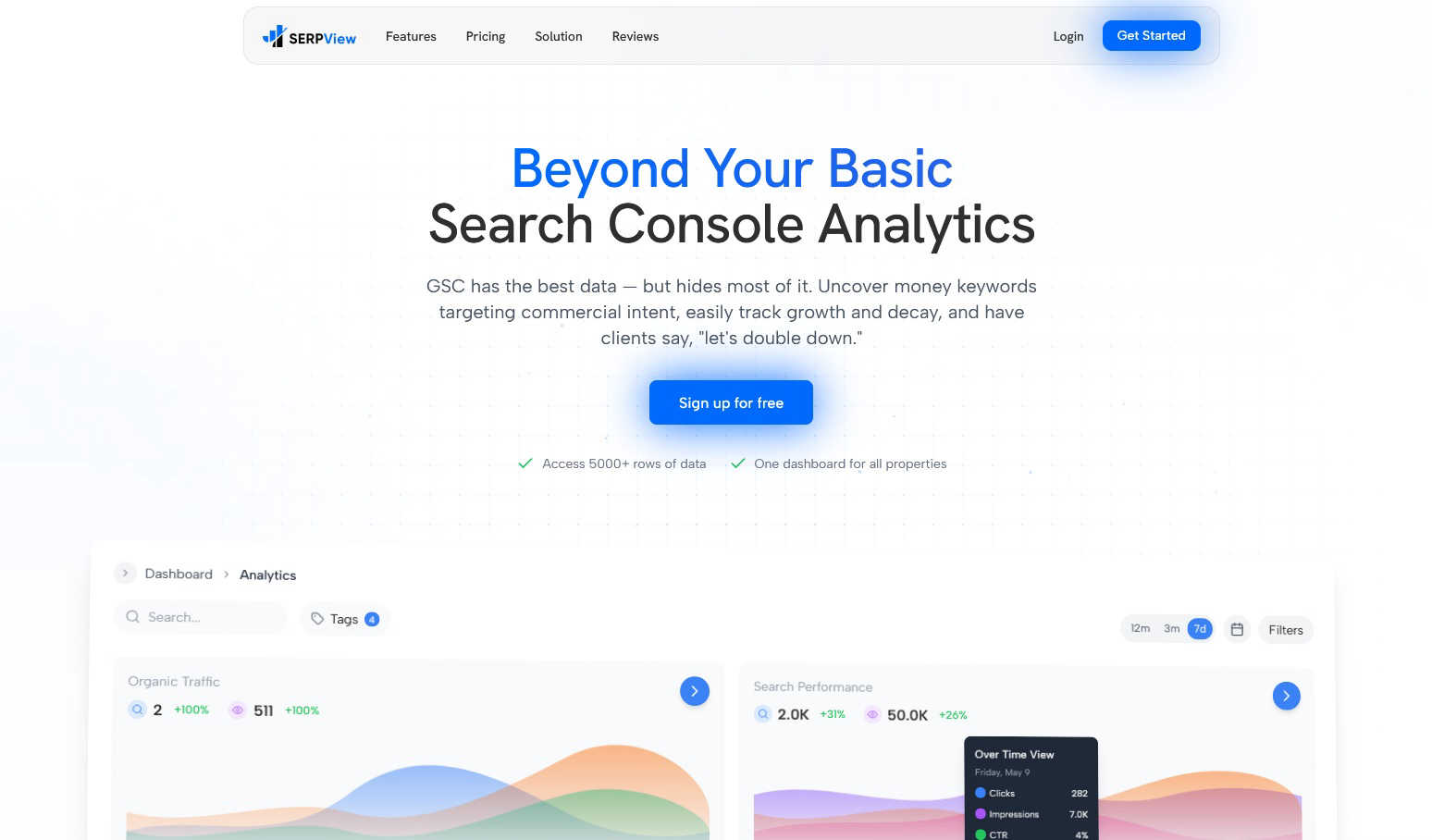
SERPView unlocks hidden Google Search Console data to reveal growth opportunities and track SEO performance.
Last updated: March 1, 2026
Visual Comparison
Customer Feedback

SERPView
Feature Comparison
Customer Feedback
Collect Feedback Everywhere
With Customer Feedback, businesses can seamlessly collect user feedback from multiple sources, ensuring that no insight goes unnoticed. Whether through embedded widgets, customizable forms, or wishlist features, this tool offers flexibility in gathering input from customers wherever they are. This omnichannel approach ensures comprehensive data collection that reflects user sentiments accurately.
AI-Driven Insights
Stop drowning in raw comments and let Customer Feedback’s AI capabilities do the heavy lifting. The tool analyzes feedback quickly, identifying patterns and trends that would be time-consuming to discern manually. This feature allows businesses to focus on strategic decisions rather than getting bogged down in data, ultimately accelerating growth and improving customer experiences.
Easy Update Sharing
Keeping users informed is crucial for maintaining engagement, and Customer Feedback simplifies this process. With the tool's easy sharing capabilities, businesses can share updates and improvements based on user feedback effortlessly. This transparent communication fosters a sense of community among users, ensuring they feel valued and heard.
Customizable Feedback Options
Customer Feedback offers a range of customizable options for collecting feedback, allowing businesses to tailor their approach to meet specific needs. Users can choose from various question types, formats, and designs to ensure that the feedback collection process aligns with their brand and engages customers effectively.
SERPView
Unlocked Performance Tracking
Move beyond the restrictive 1,000-row limit of Google Search Console. SERPView grants you access to over 50,000 rows of granular performance data, allowing you to track clicks, impressions, CTR, and average position across your entire site without any artificial constraints. This comprehensive view is essential for identifying long-tail opportunities and understanding true performance trends that basic tools miss.
Advanced Keyword & Page Analysis
Progress from simple ranking checks to strategic intent analysis. Uncover "money keywords" that signal strong commercial intent and track their position changes over time. Simultaneously, analyze page-level performance to instantly identify your top-performing content and spotlight underperforming pages that require optimization or consolidation, turning data into direct content strategy actions.
Cross-Device & International Insights
Evolve your strategy with segmented performance intelligence. Compare your search performance across mobile and desktop devices to identify optimization opportunities for each. Furthermore, track your rankings and traffic across different countries and languages, empowering you to tailor and refine your global SEO strategy with region-specific data and insights.
Topic Cluster & Algorithm Correlation Tracking
Advance your content strategy from single-page focus to topic authority. SERPView allows you to track the performance of entire topic clusters, giving you a holistic view of your content strategy's effectiveness. Additionally, correlate your ranking changes with Google's official algorithm updates and add custom annotations for site changes, transforming volatility into understandable cause-and-effect narratives.
Use Cases
Customer Feedback
Enhancing Product Development
Customer Feedback can be instrumental in guiding product development. By gathering insights directly from users, businesses can identify areas for improvement, prioritize features, and make informed decisions that align with customer needs. This iterative process enhances product offerings and increases user satisfaction.
Boosting Customer Engagement
Businesses can use Customer Feedback to boost engagement by actively seeking user opinions and demonstrating that their feedback is valued. By implementing changes based on suggestions and communicating these updates, companies create a loyal customer base that feels invested in the brand’s journey.
Improving Customer Support
The tool can help organizations refine their customer support strategies by analyzing feedback on service quality. Understanding user experiences allows businesses to address pain points, train support staff effectively, and enhance overall service quality, leading to happier customers.
Driving Marketing Strategies
Customer Feedback can provide critical insights into user preferences and behaviors, enabling businesses to tailor their marketing strategies. By understanding what resonates with customers, companies can create targeted campaigns that improve conversion rates and maximize return on investment.
SERPView
For SEO Agencies Managing Multiple Clients
Agencies can seamlessly connect all client GSC properties into one unified dashboard, eliminating the need to constantly switch accounts. This centralized view, combined with deep data access and shareable reports, streamlines client reporting, improves coordination across teams, and provides a superior, data-rich service that demonstrates clear value and strategic insight.
For In-House Teams Driving Content Strategy
Content and SEO managers can move beyond guessing which topics resonate. By analyzing full topic cluster performance and uncovering high-intent keywords hidden beyond the 1,000-row limit, teams can make informed decisions on which content to update, expand, or retire, ensuring every piece aligns with user demand and business goals.
For E-commerce Sites Optimizing for Commercial Intent
Online stores can use SERPView to drill deep into keyword data to identify and prioritize product and category pages targeting commercial search queries. Tracking performance across devices helps optimize for mobile shoppers, while international insights support global expansion efforts by highlighting high-potential regional markets.
For Websites Recovering from Algorithm Updates
Site owners affected by search volatility can use the annotation feature to map traffic drops or gains directly against Google's core updates or their own site changes. This correlation turns confusing ranking fluctuations into a diagnostic timeline, providing clarity and direction for recovery efforts and future update preparedness.
Overview
About Customer Feedback
Customer Feedback is an innovative tool designed to enhance the way businesses collect and analyze feedback from their users. This all-in-one platform is perfect for companies of all sizes, empowering them to gather insights through various channels, including widgets, forms, and wishlists. By leveraging advanced AI technology, Customer Feedback streamlines the process of identifying patterns and trends in user comments, allowing businesses to focus on what truly matters. The main value proposition lies in its ability to transform raw feedback into actionable insights, enabling organizations to make informed decisions and foster better relationships with their customers. With features that promote easy sharing of updates, Customer Feedback keeps users engaged, creating a continuous loop of communication that drives growth and satisfaction.
About SERPView
SERPView is the definitive evolution of search analytics, engineered for SEO professionals, digital marketers, and content creators who have progressed beyond the basic reporting of Google Search Console (GSC). It transforms the foundational, yet restricted, data from GSC into a powerful platform for strategic growth and data-driven decision-making. The core mission of SERPView is to liberate users from the limitations that hinder advanced analysis, most notably GSC's 1,000-row data cap. By unlocking access to over 50,000 rows of performance data, SERPView reveals the full, unfiltered spectrum of keyword opportunities, page-level trends, and user intent that were previously invisible. It consolidates multiple GSC properties into a single, centralized, and visual dashboard, replacing a fragmented and time-consuming workflow with a streamlined command center for organic search performance. This tool marks the critical transition from reactive reporting to proactive analysis, enabling teams to identify high-value commercial keywords, optimize comprehensive topic clusters, dissect performance across devices and countries, and correlate traffic trends with major Google algorithm updates. For any team committed to evolving their SEO strategy from guesswork to precision, SERPView is the essential upgrade.
Frequently Asked Questions
Customer Feedback FAQ
What types of feedback can I collect with Customer Feedback?
Customer Feedback allows you to collect various types of feedback, including suggestions, complaints, and feature requests. You can use different formats such as surveys, forms, and wishlists to gather comprehensive insights from your users.
How does the AI analyze feedback?
The AI in Customer Feedback analyzes user comments by identifying key phrases, sentiment, and patterns. It processes large volumes of data quickly, allowing businesses to focus on significant trends and insights rather than sifting through individual comments manually.
Can I customize the feedback collection process?
Absolutely! Customer Feedback offers customizable options that allow you to design surveys and forms according to your specific branding and user engagement strategies. You can choose question types, formats, and visual styles that best suit your needs.
How does Customer Feedback help improve user engagement?
Customer Feedback enhances user engagement by fostering a two-way communication channel. By actively seeking and acting on user feedback, businesses can demonstrate that they value customer opinions, leading to increased loyalty and ongoing interaction with the brand.
SERPView FAQ
How is SERPView different from Google Search Console?
SERPView is built directly on top of your Google Search Console data, so it uses the same authoritative source. The key evolution is in access and analysis: SERPView removes GSC's 1,000-row limit, provides a unified dashboard for multiple properties, and delivers advanced features like topic cluster tracking, commercial keyword identification, and algorithm update correlation that GSC does not offer natively.
What data limits does SERPView have?
SERPView significantly expands upon GSC's limitations. While Google Search Console caps data exports at 1,000 rows, SERPView unlocks access to over 50,000 rows of performance data for clicks, impressions, CTR, and position. This allows for a much more comprehensive and accurate analysis of your site's full search presence.
Can I connect multiple websites or GSC properties?
Yes, a core function of SERPView is consolidating multiple Google Search Console properties into a single, streamlined dashboard. This is ideal for agencies managing multiple client accounts or businesses with several domains or subdomains, eliminating the need to log in and out of different accounts to get a complete picture.
Does SERPView help track Google algorithm updates?
Absolutely. SERPView includes a feature to track official Google algorithm updates and allows you to add your own custom annotations for site changes (like a redesign or major content publish). You can then view your performance charts with these annotations overlaid, making it easy to correlate ranking changes with specific events.