
LLMWise vs PoYo API
Side-by-side comparison to help you choose the right tool.

LLMWise
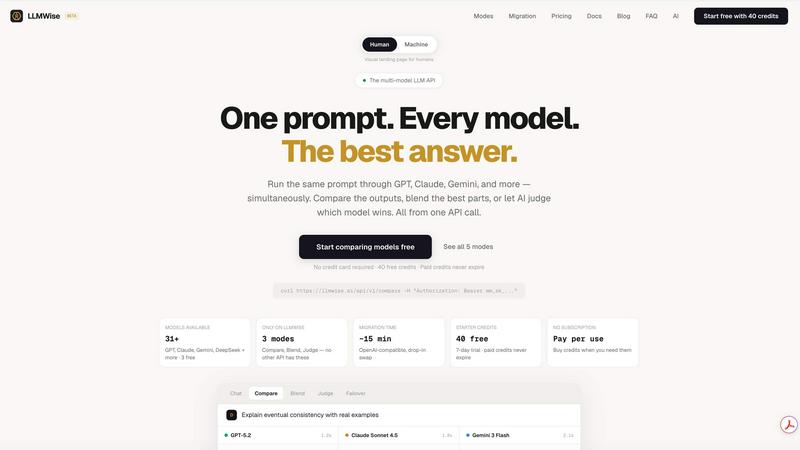
LLMWise offers a single API to effortlessly access and compare 62 AI models, charging only for what you use.
Last updated: February 28, 2026

PoYo API
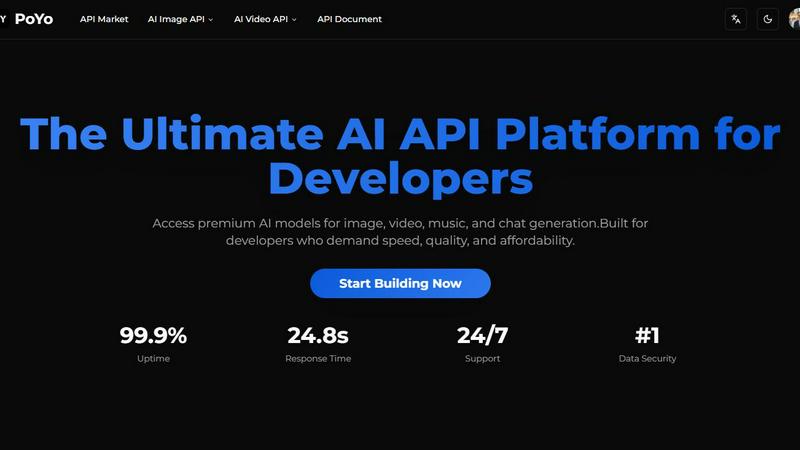
PoYo API evolves your projects with unified access to premium AI models for image, video, music, and chat.
Last updated: February 28, 2026
Visual Comparison
LLMWise
PoYo API
Feature Comparison
LLMWise
Smart Routing
LLMWise's smart routing feature automatically directs each prompt to the most appropriate model based on the task's requirements. For instance, coding prompts can be sent to GPT, while creative writing tasks are handled by Claude, and translation requests are routed to Gemini. This intelligent matching ensures that users receive the highest quality responses tailored to their specific needs.
Compare & Blend
With the compare and blend functionality, users can run prompts across multiple models side-by-side, allowing for a comprehensive evaluation of responses. The blend feature compiles the best elements from different outputs into a unified and more robust answer, while the judge mode enables models to assess and critique one another, enhancing response quality through collaborative evaluation.
Always Resilient
LLMWise is built with resilience in mind. Its circuit-breaker failover mechanism ensures continuous service by rerouting requests to backup models when a primary provider experiences downtime. This guarantees that applications remain operational and reliable, even in the face of unexpected outages, providing peace of mind for developers and businesses alike.
Test & Optimize
The platform includes advanced benchmarking suites and batch testing capabilities, empowering users to evaluate the performance of various models. Developers can implement optimization policies to prioritize speed, cost, or reliability, as well as perform automated regression checks to maintain high-quality outputs. This feature allows for continuous improvement and fine-tuning of AI interactions, ensuring optimal performance over time.
PoYo API
Unified Multi-Model Gateway
PoYo API provides a single integration point for over 500 cutting-edge AI models across image, video, music, and chat generation. This eliminates the need to source, manage, and pay for multiple APIs from different providers. Developers can seamlessly switch between models like Nano Banana for images, Sora 2 for video, Suno for music, and Claude Sonnet for chat through one consistent interface, dramatically accelerating development cycles and simplifying the entire AI stack management process.
Credit-Based, Subscription-Free Pricing
The platform operates on a flexible, growth-oriented credit system where you only pay for what you use, with no mandatory recurring subscriptions. Credits are purchased once and never expire, allowing projects to scale up or down based on actual demand without financial lock-in. This model is ideal for startups and enterprises alike, supporting the journey from initial prototype to full-scale production without the friction of unpredictable or escalating monthly costs.
Enterprise-Grade Reliability & Support
PoYo API is built on a foundation of robustness, guaranteeing 99.9% uptime and offering ultra-low latency responses, often under 50ms. It includes 24/7 monitoring and access to dedicated technical support, not automated bots, ensuring any issues are resolved promptly. This enterprise-level reliability is crucial for applications that move beyond the testing phase and require a stable, always-available infrastructure for their users.
Developer-First Tools & Playground
To accelerate the development lifecycle, PoYo provides a comprehensive free playground for testing all models without requiring a credit card. Developers can experiment with parameters, debug responses, and validate outputs before writing a single line of integration code. Coupled with a simple two-endpoint async API design for task submission and querying, the platform ensures you can progress from concept to functional integration in minutes.
Use Cases
LLMWise
Software Development
Developers can leverage LLMWise to streamline coding tasks by using the smart routing feature to send programming requests directly to models like GPT. This results in more accurate code generation and debugging assistance, significantly speeding up the development process.
Content Creation
Content creators can utilize LLMWise for diverse writing tasks such as articles, blogs, and marketing copy. By selecting the best models for creative writing, users can enhance their output quality and efficiency, allowing for greater focus on content strategy and ideation.
Translation Services
For businesses requiring translation services, LLMWise directs translation requests to the most capable models, such as Gemini. This ensures that translations are not only accurate but also contextually appropriate, thereby improving communication across different languages and cultures.
Research & Analysis
Researchers can benefit from LLMWise by comparing outputs from multiple models on complex queries or data analysis tasks. The compare and blend functionalities allow them to synthesize insights from different perspectives, leading to more comprehensive and informed conclusions.
PoYo API
Scalable Content Creation Platforms
Startups and SaaS companies building the next wave of content creation tools can leverage PoYo API to offer diverse AI generation features—from marketing images and social media videos to custom music tracks—all through a single, integrated backend. This allows them to rapidly prototype new features, scale user capacity without managing multiple vendor relationships, and maintain a consistent, high-quality output as their user base grows exponentially.
Advanced AI-Powered Chat Applications
Developers creating sophisticated conversational agents, customer support bots, or interactive storytelling apps can utilize the unified chat API to access top-tier models like GPT-5, Claude Sonnet, and Gemini. This enables easy A/B testing of different models for optimal performance and cost, and ensures the application can evolve by instantly integrating newer, more powerful models as they become available, keeping the product at the cutting edge.
Media Production & Editing Software Integration
Software companies in the creative space can integrate PoYo's AI Video and Music APIs directly into their existing video editors, DAWs (Digital Audio Workstations), or graphic design suites. This evolution allows them to add powerful AI features like text-to-video generation, style transfer, vocal removal, or song extension, transforming their traditional software into next-generation, AI-augmented creative studios for professional users.
Rapid Prototyping & MVP Development
Entrepreneurs and indie developers can use PoYo API to quickly validate business ideas and build functional Minimum Viable Products (MVPs). The free playground and simple API allow for fast experimentation across different AI modalities without upfront investment. The credit-based pricing then supports organic growth, enabling the project to scale its AI usage precisely in line with user acquisition and funding milestones.
Overview
About LLMWise
LLMWise is a revolutionary platform designed to simplify the landscape of artificial intelligence by providing a single API that grants access to a multitude of large language models (LLMs). With LLMWise, developers can seamlessly connect to leading models from providers such as OpenAI, Anthropic, Google, Meta, xAI, and DeepSeek. The primary goal of LLMWise is to eliminate the hassle of managing multiple AI subscriptions while ensuring that users can leverage the best model for each specific task. This platform is ideal for developers, startups, and enterprises looking to enhance their applications with cutting-edge AI capabilities without the complexity of juggling different APIs. By intelligently routing prompts to the most suitable model, LLMWise maximizes efficiency, boosts performance, and reduces overall costs, enabling developers to focus on innovation rather than administrative overhead.
About PoYo API
PoYo API represents the definitive evolutionary leap in AI development infrastructure, designed for builders who are progressing from fragmented prototypes to scalable, production-ready applications. It is a unified API gateway that consolidates access to over 500 premium AI models across the critical domains of image, video, music, and chat generation. This platform eliminates the developmental friction of managing dozens of separate vendor keys, subscriptions, and inconsistent integration protocols, providing a single, reliable point of access. Its core value proposition is empowering scalable innovation: developers and businesses can start with a simple idea and grow it into a robust application without hitting infrastructural or financial roadblocks. With a flexible, credit-based pricing model free from recurring subscriptions, projects can evolve organically. Backed by enterprise-grade security, consistent 99.9% uptime, and dedicated 24/7 support, PoYo API is the foundational layer upon which the next generation of ambitious AI applications are built and thrive, allowing teams to focus entirely on creation and growth rather than complex configuration.
Frequently Asked Questions
LLMWise FAQ
What types of models can I access with LLMWise?
LLMWise provides access to over 62 models from 20 different providers, including leading names like OpenAI, Anthropic, Google, and more. This extensive selection allows users to choose the best model for their specific needs.
How does the smart routing feature work?
The smart routing feature intelligently directs prompts to the most suitable model based on the nature of the task. For example, coding prompts are sent to GPT, while creative writing tasks are handled by Claude, ensuring optimal responses.
Are there any subscription fees associated with LLMWise?
LLMWise operates on a pay-as-you-go model, meaning users only pay for what they utilize. There are no subscription fees, and users can start with 20 free credits that never expire, allowing for flexible and cost-effective usage.
Can I use my existing API keys with LLMWise?
Yes, LLMWise allows users to bring their own API keys (BYOK), enabling them to integrate their existing accounts with the platform. This feature helps to cut costs and maintain continuity while benefiting from LLMWise's orchestration capabilities.
PoYo API FAQ
How does the credit-based pricing work?
PoYo API uses a flexible credit system where you purchase credits upfront. Each AI model has a cost per task (e.g., $0.025 for an image generation with Nano Banana 2). You are only charged the corresponding credit amount when you successfully use a model. There are no monthly subscriptions or recurring fees; purchased credits never expire, giving you complete control over your spending and allowing you to scale usage up or down based on your project's actual growth trajectory.
Can I test the models before purchasing credits?
Absolutely. PoYo API offers a completely free playground on its model pages. You can experiment with every available image, video, music, and chat model, fine-tuning parameters and seeing real results without needing an API key or a credit card. This is designed to help developers progress from experimentation to integration confidently, ensuring the chosen models meet their specific quality and functionality requirements before any commitment.
What happens if a generation task fails?
PoYo API is built for reliability. In the rare event a generation task fails due to a system issue, you are not charged any credits for that attempt. The platform provides manual retry options directly from your dashboard, and for automated workflows, it supports webhook callbacks to notify your application of task status. This ensures you only pay for successful outputs, protecting your development budget and maintaining trust as you scale.
How do you ensure the security of my API keys and data?
Security is foundational. PoYo API employs enterprise-grade measures, storing all API keys in an encrypted format using industry-standard protocols. We operate on a zero-knowledge architecture principle where possible, meaning your sensitive credentials are fully protected. Additionally, the platform provides full audit logging for all API activities, enabling compliance monitoring and giving you complete visibility into how your integration is being used as your application evolves.
Alternatives
LLMWise Alternatives
LLMWise is an advanced AI integration platform that provides a single API to access multiple large language models (LLMs), including those from major providers like OpenAI, Anthropic, Google, and others. This innovative solution eliminates the complexity of managing various AI services by intelligently routing user prompts to the most suitable model for each task. Users appreciate its flexibility and resilience, as it ensures that applications remain operational even during outages. Many users seek alternatives to LLMWise due to factors such as pricing structures, feature sets, or specific platform requirements. When choosing an alternative, it's essential to consider the ease of integration, the range of models offered, and the reliability of the service. Look for solutions that provide a strong balance of performance, cost-effectiveness, and adaptability to your unique needs, ensuring you can harness the best AI capabilities available.
PoYo API Alternatives
PoYo API is a unified AI development platform, specifically designed as an API gateway for AI Assistants and multi-modal applications. It provides a single point of access to a vast library of premium models for image, video, music, and chat generation, streamlining the development process. Developers often explore alternatives to find a solution that aligns with their project's specific evolutionary stage. This search can be driven by budget constraints, the need for different model specializations, or platform requirements that demand a different architectural approach or integration method. When evaluating options, consider the scope of model access, pricing flexibility, and platform reliability. The ideal alternative should support your project's growth trajectory, offering a scalable infrastructure that evolves with your needs from prototype to production without imposing restrictive financial or technical barriers.