
Interactive Circle of Fifths vs Polym
Side-by-side comparison to help you choose the right tool.

Interactive Circle of Fifths
Master music theory from scales to chords and unlock your creative evolution with this interactive guide.
Last updated: March 1, 2026

Polym evolves your learning with audio courses and active recall to master foundational knowledge.
Last updated: March 1, 2026
Visual Comparison
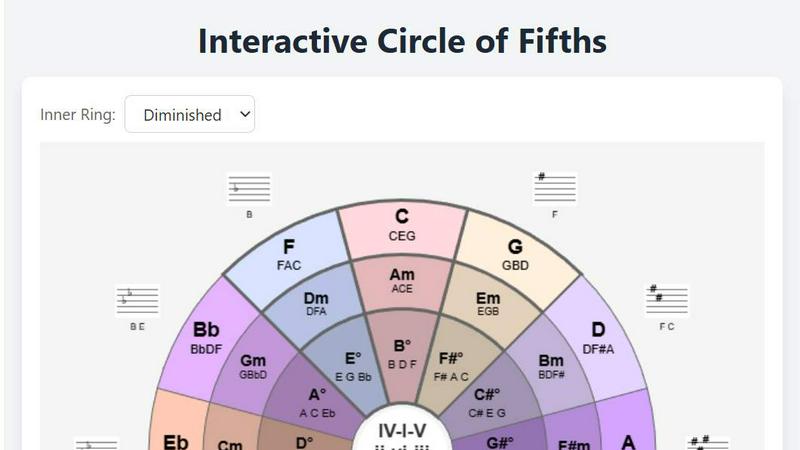
Interactive Circle of Fifths
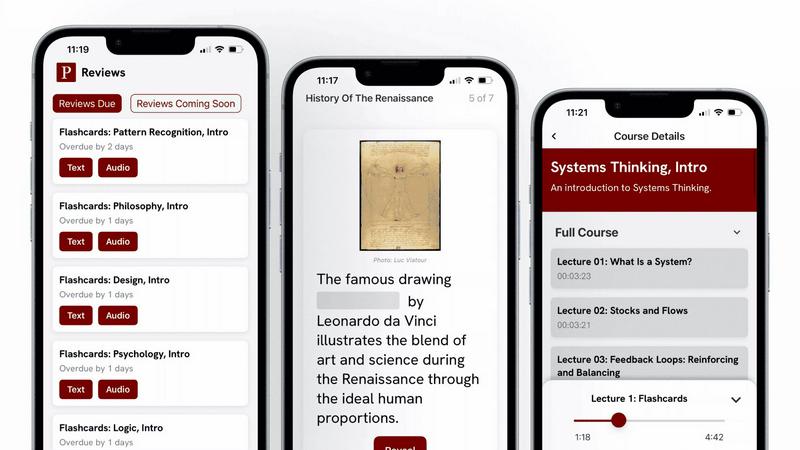
Polym
Feature Comparison
Interactive Circle of Fifths
Dynamic Circle of Fifths Interface
The central, interactive wheel allows you to click on any key and instantly see the entire harmonic universe related to it. This includes the corresponding major and minor scales, all diatonic chords (I, ii, iii, IV, V, vi, vii°), and their relationships. This dynamic visualization helps you internalize the foundational structure of music theory, moving from memorization to genuine understanding as you explore how keys connect and relate to one another.
Multi-Scale Exploration Hub
Go beyond basic scales with dedicated access to essential musical colors. The inner ring and panel let you instantly visualize and hear the Pentatonic, Blues, Diatonic, and Diminished scales in any selected key. This feature is crucial for evolving musicians who want to expand their melodic vocabulary and understand the unique emotional character each scale brings to improvisation and songwriting, providing a clear path from basic theory to advanced application.
Integrated Instrument Visualizers
Accelerate your instrumental progress with synchronized piano and guitar fingerboard displays. When you select a chord or scale, the tool visually maps out the correct notes and optimal fingerings on both instruments. This bridges the gap between theoretical knowledge and physical execution, helping you translate what you see on the circle directly to your instrument, drastically reducing the learning curve for practical mastery.
Harmonized Scale & Chord Sequencer
This powerful panel displays all the chords within a key (e.g., C, Dm, Em, F, G, Am, B°) alongside their scale degrees (I, ii, iii, etc.) and harmonic function. It acts as a creative sandbox for building chord progressions. You can experiment with how chords naturally resolve (e.g., V to I), empowering you to compose more compelling music and understand the "why" behind the progressions you hear in songs, marking a significant evolution in your compositional skills.
Polym
Medium-Form Foundational Courses
Polym offers in-depth, medium-form audio courses designed to build a robust understanding of core subjects. These courses are carefully crafted to translate technical and mathematical concepts into engaging audio narratives, focusing on abstract principles that strengthen your ability to apply knowledge across various contexts, moving you from novice to competent in essential fields.
Active Learning with Retrieval Practice
To cement knowledge, Polym utilizes retrieval practice, a core cognitive science principle. This feature presents you with audio flashcard-style prompts and questions, forcing your brain to actively recall information. This active struggle is proven to forge stronger neural pathways, transforming fragile memories into durable, long-term knowledge you can reliably access.
Spaced Repetition Scheduling
The app intelligently manages your review schedule using spaced repetition algorithms. It prompts you to revisit key concepts at strategically increasing intervals, precisely when you are most likely to forget them. This systematic approach maximizes memory consolidation, ensuring your learning progresses efficiently and endures far beyond a single study session.
Interleaved Practice Sessions
Polym enhances learning by mixing related topics from different courses during practice sessions, a technique known as interleaving. Instead of drilling one subject in isolation, you'll encounter varied problems and concepts in a shuffled order. This builds cognitive flexibility, deepens your understanding of connections between fields, and improves your ability to apply knowledge in novel situations.
Use Cases
Interactive Circle of Fifths
Accelerating Beginner Music Theory
For those starting their musical journey, the tool demystifies intimidating concepts. A beginner can click on the key of C Major and immediately see all the simple, white-note chords that sound good together. By visually connecting the Circle to the piano keys and chord names, they build a solid, intuitive foundation faster than with traditional methods, setting the stage for rapid initial growth.
Songwriting and Chord Progression Development
Songwriters can break out of creative ruts by using the Harmonized Scale panel and Chord Sequencer. By experimenting with different chord functions like the tension of the V chord resolving to the stable I, or exploring the melancholic sound of a vi chord, writers can efficiently craft emotionally resonant progressions and discover new harmonic pathways for their songs.
Targeted Instrument Practice and Improvisation
Guitarists and pianists can use the tool for focused practice sessions. By selecting a scale like the Blues scale in A, the visualizer shows the exact fretboard or keyboard patterns. Musicians can practice these shapes while hearing the scale, then use the chord display to target their improvisation over a standard 12-bar blues progression, translating theory into immediate, practical skill evolution.
Advanced Harmonic Analysis and Study
Advanced students and teachers can delve into deeper concepts like secondary dominants or modal interchange by using the Circle to quickly pivot to related keys. The clear labeling of scale degrees and chord quality (like the diminished vii° chord) makes it an excellent tool for analyzing existing music or understanding sophisticated jazz harmony, supporting continuous evolution at an expert level.
Polym
The Aspiring Polymath's Daily Ritual
For individuals driven to build broad, interdisciplinary expertise, Polym turns daily routines like commutes or walks into structured learning sessions. The app provides a curated path through foundational subjects, using spaced repetition and interleaving to help weave disparate fields like philosophy, economics, and computer science into a coherent, interconnected web of knowledge.
The Professional Seeking Intellectual Edge
Professionals in fast-evolving fields use Polym to continuously reinforce and expand their foundational knowledge. A data scientist can solidify statistics concepts, a manager can internalize logical fallacies, and a developer can grasp core AI principles—all through audio sessions that fit into a busy schedule, ensuring their foundational skills remain sharp and applicable.
Combating Knowledge Decay Post-Formal Education
For graduates and lifelong learners, Polym addresses the natural fading of knowledge learned in school or from books. By providing systematic review of key terms and concepts in subjects like logic, economics, and probability through audio flashcards and abbreviated courses, it helps rebuild and permanently retain that foundational understanding.
Preparing for Advanced Study or Career Transitions
Individuals preparing for graduate studies, certifications, or a career pivot use Polym to efficiently build or refresh prerequisite knowledge. The audio-first format allows for immersive learning during downtime, while the active recall features ensure the material is truly mastered, creating a solid platform for the next stage of their educational or professional evolution.
Overview
About Interactive Circle of Fifths
The Interactive Circle of Fifths is a transformative digital tool designed to accelerate your musical evolution. It moves beyond the static, printed diagram to become a dynamic, hands-on learning environment that makes complex music theory intuitive and actionable. This product is crafted for musicians at every stage of their journey, from the beginner taking their first steps in understanding keys and chords, to the advanced player seeking to master sophisticated harmonic relationships and improvisation techniques. Its core value proposition lies in its ability to visually and audibly map the intricate connections within music, turning abstract theory into a clear, navigable landscape. By integrating detailed piano and guitar visualizers, it bridges the gap between theoretical knowledge and practical application on your instrument. Whether you are exploring foundational major and minor chords, delving into the emotional color of pentatonic and blues scales, or constructing complex progressions with the harmonized scale and chord sequencer, this tool provides the structured pathway for continuous growth. It is more than a reference; it's an essential companion that empowers you to see, hear, and understand the building blocks of music, fostering a deeper creative confidence and enabling tangible progress in composition, improvisation, and overall musical fluency.
About Polym
Polym represents the next evolutionary stage in personal knowledge acquisition, transforming idle listening time into a powerful engine for cognitive growth. It is an audio app meticulously engineered for the modern polymath, the curious professional, and anyone committed to the continuous compounding of their foundational knowledge. Moving beyond passive podcasts or linear audiobooks, Polym integrates proven cognitive science principles directly into its content structure to solve the universal learner's challenge: forgetting. The app offers a curated library of medium-form courses, abbreviated reviews, and interactive audio flashcards across essential, interdisciplinary subjects like Statistics, Probability, Logic, Economics, Computer Science, AI, and Philosophy. By strategically employing retrieval practice, spaced repetition, and interleaving, Polym doesn't just deliver information; it architects its long-term retention and recall. This is for those who view knowledge as a lifelong asset, who seek to connect disparate fields, and who want their daily commute, walk, or downtime to actively contribute to building a more resilient, interconnected, and applicable understanding of the world. Polym is where listening evolves into learning that lasts.
Frequently Asked Questions
Interactive Circle of Fifths FAQ
Who is the Interactive Circle of Fifths for?
The tool is designed for musicians at all levels. Beginners will find it an invaluable guide for unlocking the basics of keys and chords. Intermediate players use it to deepen their understanding of scales and harmony for improvisation and songwriting. Even advanced musicians and educators utilize it as a quick-reference tool for analysis, teaching, and exploring complex chord relationships, making it a lifelong companion for musical growth.
How do the Piano and Guitar Visualizers help me learn?
The visualizers directly connect music theory to your instrument. When you select a chord or scale, the tool displays the exact notes and suggested fingerings on a virtual piano keyboard or guitar fretboard. This allows you to see the theoretical shape in a practical context, helping you memorize patterns, understand the geometry of the instrument, and apply new concepts immediately in your playing, accelerating hands-on progress.
What is the "Harmonized Scale" and how do I use it?
The Harmonized Scale shows every chord that naturally occurs within a chosen key. For example, in C Major, it lists C (I), Dm (ii), Em (iii), F (IV), G (V), Am (vi), and B° (vii°). You use it to understand chord relationships and build progressions. By clicking on chords and seeing their "Function" and "Resolves To" hints, you learn how to create movement and tension/release in your music, evolving from playing random chords to crafting intentional harmonies.
Can I use this tool to learn scales beyond major and minor?
Absolutely. A core feature is the exploration of essential scales like Pentatonic (for rock and pop solos), Blues (for its distinctive sound), Diatonic (the full major scale), and Diminished (for jazz and tension). By selecting your root key and then choosing one of these scales, you can see and hear its unique pattern, understanding its application and expanding your melodic vocabulary far beyond basic major and minor.
Polym FAQ
What research supports the learning strategies Polym uses?
The strategies of retrieval practice, spaced repetition, and interleaving are among the most robustly supported findings in cognitive science. Decades of research, often summarized under terms like "desirable difficulties," show they significantly enhance long-term retention and recall compared to passive re-reading or massed practice. You can explore a comprehensive overview in resources like the article "How to Use Spaced Retrieval Practice to Boost Learning" available through the National Institutes of Health.
What subjects does Polym cover?
Polym focuses on foundational, interdisciplinary subjects that are relevant across professional and personal life. The curriculum includes Logic, Logical Fallacies, Cognitive Biases, Statistics, Probability, Scientific Research, Algorithms, Economics, Philosophy, and History. The selection is designed to build a versatile and resilient knowledge base.
Who is Polym designed for?
Polym is designed for anyone who views knowledge as a compounding asset and is committed to lifelong learning. It is ideal for curious professionals, aspiring polymaths, students, and autodidacts who want to move beyond passive content consumption and actively build a durable understanding of essential concepts that apply to a wide range of fields and decision-making in everyday life.
How does Polym handle technical content in an audio format?
Polym carefully curates a subset of technical and mathematical material that is suitable for audio learning. The courses focus on explaining abstract concepts, principles, and relationships rather than presenting dense equations or code. This approach strengthens conceptual understanding, which is often the key to applying technical knowledge effectively in varied contexts.
Alternatives
Interactive Circle of Fifths Alternatives
The Interactive Circle of Fifths is a dynamic educational tool in the music theory space, designed to help musicians visualize and understand the foundational relationships between scales, chords, and keys. It represents a significant step in a musician's evolution, moving from rote memorization to intuitive comprehension through interactive features like instrument visualizers and chord sequencers. Musicians often explore alternatives to find a tool that aligns with their specific stage of growth. This search can be driven by budget considerations, a need for different platform compatibility like mobile apps versus desktop software, or a desire for features tailored to a particular genre or learning style. The journey to mastery is personal, and the right tool should adapt to your unique path. When evaluating other options, consider how a tool supports your progression. Look for clear visualizations that build your theory knowledge, practical features that translate to your instrument, and a design that grows with you from fundamental concepts to advanced harmonic exploration. The goal is to find a resource that not only teaches but evolves alongside your developing skills.
Polym Alternatives
Polym is an audio learning platform in the education technology category, designed to build foundational knowledge through active recall and spaced repetition. It transforms passive listening into an active memory-forging experience for curious learners. Users often explore alternatives for various reasons, such as seeking different pricing models, preferring video-based or text-based content over audio, needing platform-specific apps, or desiring a broader course library that includes more niche or advanced topics. The search for the right tool is a natural step in evolving one's personal learning system. When evaluating alternatives, consider your primary learning stage and goals. Look for platforms that match your preferred content format, reinforce knowledge through proven techniques like active recall, and fit seamlessly into your daily routine. The right tool should feel like a natural evolution in your journey toward becoming a more effective and resilient learner.