
Agent to Agent Testing Platform vs SVG to 3D
Side-by-side comparison to help you choose the right tool.

Agent to Agent Testing Platform
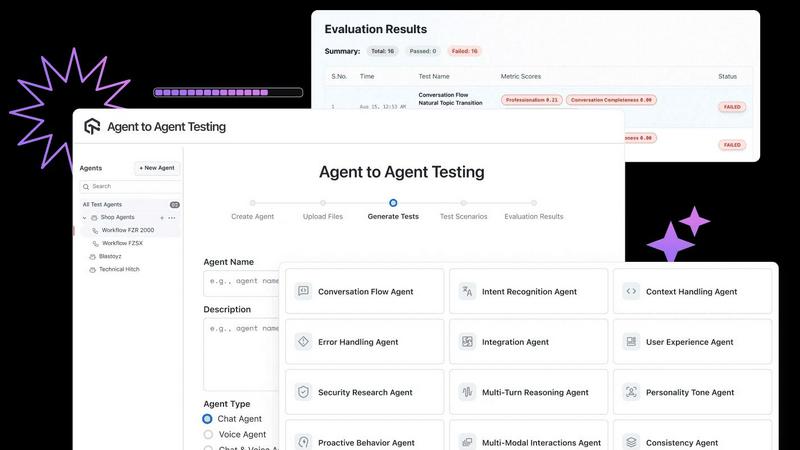
Validate and enhance AI agent performance across chat, voice, and phone systems to ensure security and compliance.
Last updated: February 28, 2026
SVG to 3D
Evolve your 2D SVG designs into professional 3D models instantly and for free.
Last updated: February 28, 2026
Visual Comparison
Agent to Agent Testing Platform
SVG to 3D
Feature Comparison
Agent to Agent Testing Platform
Automated Scenario Generation
The platform utilizes automated scenario generation to create a wide array of diverse test cases for AI agents. These scenarios simulate interactions across chat, voice, and phone modalities, ensuring that agents are rigorously tested under conditions that closely mirror real-world usage.
True Multi-Modal Understanding
Agent to Agent Testing allows users to define detailed requirements or upload Product Requirement Documents (PRDs) that include various inputs such as images, audio, and video. This multi-modal approach helps to evaluate the expected output of the agent, thereby reflecting real-world complexities.
Autonomous Test Scenario Generation
Access a comprehensive library of hundreds of predefined scenarios or create custom scenarios tailored to specific testing needs. This feature enables users to assess various aspects of AI agent functionality, including personality tone, data privacy, and intent recognition.
Regression Testing with Risk Scoring
The platform offers end-to-end regression testing capabilities accompanied by insightful risk scoring. This feature highlights potential areas of concern, allowing teams to prioritize critical issues and streamline their testing efforts for optimal performance.
SVG to 3D
Browser-Based Modeling Studio
This feature eliminates the need for software installation, representing a leap forward in accessibility. You can perform complex 3D modeling directly in your web browser with a real-time preview. It goes beyond simple extrusion, allowing for fine-tuned control over critical parameters like model thickness, bevel depth and complexity, and the application of advanced PBR (Physically-Based Rendering) materials. This evolution from a basic converter to an in-browser studio enables professional-grade detailing without ever leaving your workflow.
Web-Optimized GLB/GLTF Export
Specializing in outputs for modern web development, this tool generates lightweight, high-performance GLB and GLTF files. These exports are meticulously optimized to be dropped directly into projects using popular frameworks like Three.js or React Three Fiber. This feature is designed for developers in their growth phase, who need to quickly integrate 3D models without dealing with bloated files or complex optimization steps, making the path from Figma to an interactive 3D web element seamless.
3D-Print Ready STL Generation
Catering to the growth of maker culture, SVG to 3D produces clean, watertight STL files ready for 3D printing. The tool ensures the geometry is optimized for fabrication, avoiding the messy and non-manifold edges common in basic converters. This allows designers and creators to progress from a digital 2D asset to a physical 3D object without requiring intermediate, complex CAD software, streamlining the entire prototyping and creation pipeline.
Privacy-First Local Processing
In an era of growing data sensitivity, this feature represents a mature step in user-centric design. When possible, your SVG files are processed entirely locally within your browser, with no upload to external servers. This ensures complete privacy and security for your proprietary designs and logos, allowing professionals and companies to use the tool with confidence at any stage of their project development.
Use Cases
Agent to Agent Testing Platform
Quality Assurance for Chatbots
Enterprises can leverage the platform to perform comprehensive testing of chatbots, ensuring they respond accurately and effectively to user inquiries. By simulating a variety of user interactions, businesses can enhance their chatbot's reliability and user experience.
Voice Assistant Validation
Organizations deploying voice assistants can utilize the platform to validate their performance in nuanced, multi-turn conversations. This comprehensive testing ensures that voice agents can understand and respond appropriately in real-world scenarios.
Phone Caller Agent Testing
The platform supports testing for phone caller agents, enabling businesses to assess their performance in voice-based interactions. This use case is critical for customer service environments where AI agents must handle complex queries effectively.
Persona-Based Testing
By simulating diverse user personas, companies can ensure that their AI agents are equipped to handle a wide range of user behaviors and needs. This feature helps in enhancing the overall user experience by ensuring that the AI agents cater to different demographics effectively.
SVG to 3D
Creating Interactive Web Graphics
Web developers and digital designers use SVG to 3D to rapidly evolve static website elements into engaging 3D experiences. Converting logos, icons, and UI components from SVG to GLB allows for the creation of interactive models that enhance user engagement and visual appeal, seamlessly integrating with JavaScript libraries to bring a new dimension of professionalism to online portfolios, product showcases, and landing pages.
Prototyping for 3D Printing
This use case accelerates the journey from concept to physical object. Hobbyists, engineers, and artists can transform 2D vector drawings, logos, or custom text into printable 3D models. By exporting a clean STL file, users bypass the steep learning curve of traditional CAD modeling, enabling faster iteration and prototyping for custom parts, artistic pieces, or personalized gifts directly from their initial designs.
Enhancing UI/UX Design Presentations
UI/UX designers leverage this tool to add depth and realism to their mockups and presentations. By converting interface elements from tools like Figma into 3D models, they can create more compelling and realistic prototypes. This evolution in presentation style helps stakeholders better visualize the final product, effectively communicating concepts for buttons, cards, and other components with realistic lighting and materials.
Developing Game Assets and Visualizations
Indie game developers and data visualization specialists find value in quickly generating base 3D meshes from vector art. Simple icons, environment markers, or stylized text can be converted and extruded into 3D models that serve as starting points for more detailed game assets or as clean, performant models for real-time data visualizations and infographics, speeding up the initial asset creation phase.
Overview
About Agent to Agent Testing Platform
Agent to Agent Testing Platform is a revolutionary AI-native quality assurance framework specifically designed to validate the behavior of AI agents in real-world scenarios. As AI systems gain more autonomy and unpredictability, traditional quality assurance methods, which are typically designed for static software, are no longer adequate. This platform transcends basic prompt-level checks by assessing full, multi-turn conversations across various modalities, including chat, voice, and phone interactions. Its main value proposition is to provide enterprises with a reliable means to validate AI agents before they are deployed in production environments. With the ability to generate multi-agent tests using over 17 specialized AI agents, the platform uncovers long-tail failures, edge cases, and interaction patterns that manual testing often overlooks. This ensures that the AI agents perform effectively and seamlessly in diverse real-world applications.
About SVG to 3D
SVG to 3D represents a significant evolution in the democratization of 3D content creation. Born from the frustration of needing heavyweight, complex software for simple tasks, this tool marks a pivotal stage in the growth of digital design workflows. It is a browser-based platform engineered to instantly transform 2D SVG vector graphics into high-quality, production-ready 3D models. The product's core mission is to streamline and accelerate the process, eliminating the traditional barrier of specialized 3D modeling knowledge. It serves a diverse community of professionals in their growth journey: web developers seeking to add interactive 3D elements to sites, UI/UX designers wanting to present concepts with depth, and 3D printing enthusiasts looking to bring digital art into the physical world. By focusing on a single, powerful transformation—SVG to 3D—it provides a faster, more accessible, and more efficient solution, empowering users to progress from a flat design to a tangible, three-dimensional asset in a matter of seconds, entirely within their browser.
Frequently Asked Questions
Agent to Agent Testing Platform FAQ
What is Agent to Agent Testing?
Agent to Agent Testing is an AI-native framework designed to validate the behavior of AI agents across various modalities in real-world scenarios, ensuring they perform effectively before deployment.
How does the platform ensure comprehensive testing?
The platform utilizes automated scenario generation and multi-agent test creation to cover a wide range of interactions and edge cases that manual testing may miss, providing a thorough assessment of AI agents.
Can I create custom test scenarios?
Yes, users can access a library of predefined scenarios and also have the flexibility to create custom scenarios tailored to their specific testing needs, enhancing the relevance of the tests.
What kind of metrics can be evaluated?
The platform evaluates critical metrics such as bias, toxicity, hallucinations, effectiveness, accuracy, empathy, and professionalism, providing a detailed analysis of AI agent performance.
SVG to 3D FAQ
What file formats can I export my 3D model to?
SVG to 3D supports exporting your creations in multiple industry-standard formats to fit your project's growth stage. You can download your model as a GLB or GLTF file for web and real-time applications, as an OBJ file for broader 3D software compatibility, or as an STL file ready for 3D printing. This flexibility ensures your asset can progress into any pipeline.
Is there a file size limit for the SVG upload?
Yes, to ensure fast processing and a smooth experience for all users, there is a maximum file size limit. Currently, you can upload SVG files up to 5 MB. For complex designs, we recommend optimizing your SVG file beforehand to ensure the best and quickest conversion results as you scale your projects.
Do I need to create an account to use the tool?
No, you do not. SVG to 3D is committed to removing barriers to entry. You can start converting your files immediately without any registration or sign-up process. This allows for instant experimentation and growth in your 3D modeling capabilities, completely free and with no commitment required.
How does the tool handle the privacy of my designs?
Privacy is a core principle. The tool is designed to process your files locally within your browser whenever possible. This means your SVG data and the resulting 3D model are never sent to our servers unless necessary for complex processing, ensuring your proprietary designs and work-in-progress concepts remain secure and confidential throughout your creative evolution.
Alternatives
Agent to Agent Testing Platform Alternatives
The Agent to Agent Testing Platform is a pioneering solution in the realm of AI assistants, designed to validate the behavior of AI agents across a variety of communication channels, including chat, voice, and multimodal systems. As organizations increasingly rely on AI-driven solutions, they often seek alternatives due to factors such as pricing, feature set, or specific platform needs that may not align with their operational requirements. Additionally, some users may desire enhanced capabilities or more tailored functionalities that better suit their unique workflows. When considering alternatives, it’s crucial to evaluate the core features that matter most to your organization. Look for a solution that offers comprehensive validation methods, scalability for testing multiple interactions, and robust security and compliance measures. Prioritize platforms that can adapt to the evolving landscape of AI technology, ensuring that they can meet your long-term quality assurance goals effectively.
SVG to 3D Alternatives
SVG to 3D is a specialized AI assistant designed to streamline the creative workflow by instantly converting 2D vector graphics into 3D models. It belongs to the category of design automation tools, helping users bypass the steep learning curve of traditional 3D software for simple tasks like extruding logos or icons. Users often explore alternatives for various reasons. Some may seek different pricing models, require more advanced modeling features, or need integration with specific platforms beyond web development and 3D printing. Others might be looking for offline capabilities or a different balance between simplicity and control. When evaluating other tools, consider your primary goal. Is it for rapid web prototyping, creating detailed models for animation, or preparing files for manufacturing? The ideal alternative should match your technical skill level, output format needs, and the complexity of the 3D effects you wish to achieve, ensuring it supports your project's growth stage.