
CCAPI vs HookMesh
Side-by-side comparison to help you choose the right tool.

CCAPI
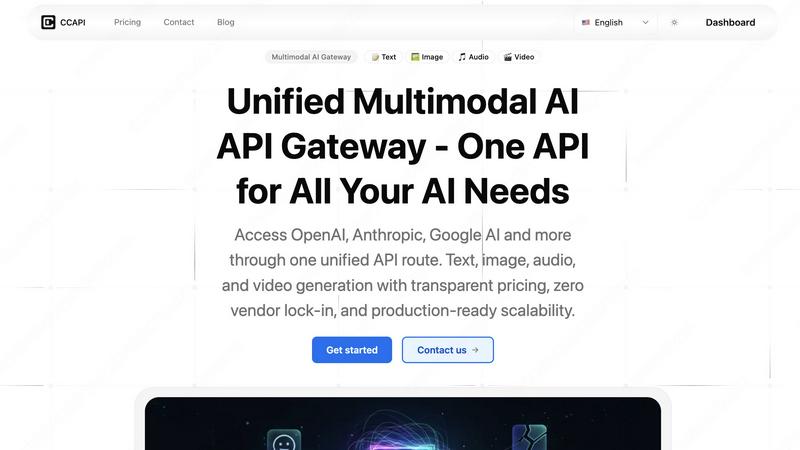
CCAPI evolves your AI workflow with one unified gateway for all major models, ensuring constant uptime.
Last updated: February 28, 2026

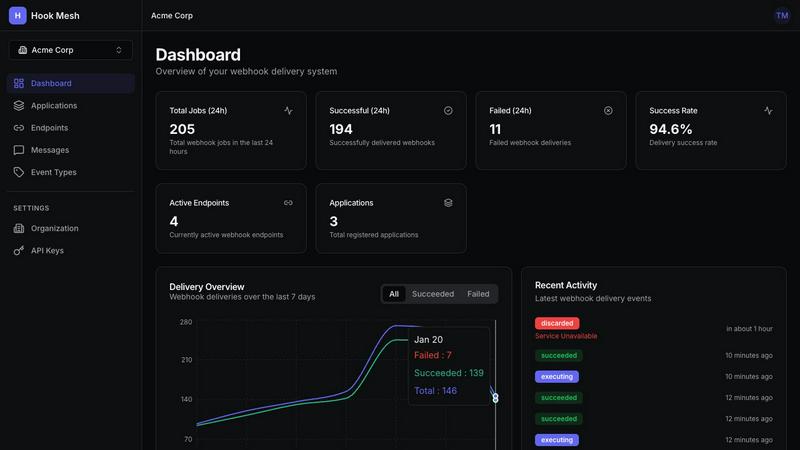
HookMesh simplifies webhook delivery with reliable automation, retries, and a self-service portal for seamless.
Last updated: February 28, 2026
Visual Comparison
CCAPI
HookMesh
Feature Comparison
CCAPI
Unified Multimodal API
CCAPI consolidates access to a vast ecosystem of AI models across text, image, audio, and video generation into a single, consistent API endpoint. Instead of learning and integrating the unique quirks of each provider's interface, developers interact with one standardized, OpenAI-compatible protocol. This dramatically simplifies codebases, reduces development time, and allows teams to effortlessly experiment with and switch between the latest models from companies like OpenAI, Anthropic, Google, and cutting-edge video specialists like Kuaishou (Kling 3.0) and ByteDance (Seedance 2.0) without changing their core application logic.
Intelligent Smart Routing & Auto-Failover
This feature is the engineering backbone that guarantees the "Always On" service level. CCAPI's smart router continuously monitors the health and performance of all connected AI providers. If a request to one provider fails or times out, the system automatically and seamlessly reroutes the request to an alternative provider in approximately 120 milliseconds. This multi-layered retry logic ensures that your end-users never experience downtime due to a third-party API outage, transforming potential application failures into mere blips handled gracefully under the hood.
OpenAI-Compatible Endpoint
Adoption is designed to be instantaneous. CCAPI's API is fully compatible with the OpenAI SDK specification. For developers, integration is as simple as changing the baseURL in their existing OpenAI client configuration to https://api.ccapi.ai/v1. This means all existing code, patterns, and SDKs (like the official OpenAI Node.js or Python libraries) work immediately, requiring zero rewrite or migration effort. It's a plug-and-play upgrade that unlocks a world of models without technical debt.
Transparent Usage & Cost Dashboard
CCAPI provides developers with complete financial and operational visibility. The dashboard offers real-time metrics on costs, per-request latency, and success rates across all providers and models. You track exactly how much you spend on each model, like GPT-5.2 or Claude 4.6, in real USD. This transparency, combined with the pay-as-you-go model (where $100 deposited equals $100 of usable balance), eliminates subscription lock-in and confusing credit systems, putting developers in full control of their AI spending.
HookMesh
Reliable Delivery
HookMesh guarantees that webhook events are never lost. With automatic retries, it implements an exponential backoff strategy that intelligently spaces out retries over a period of up to 48 hours. This ensures that even in the face of temporary failures, your webhook messages are persistently sent until confirmed as received.
Circuit Breaker
The circuit breaker feature automatically disables failing endpoints to prevent them from clogging your webhook delivery queue. Once the issue is resolved, the endpoint can be re-enabled seamlessly. This proactive approach minimizes the risk of downtime affecting your entire system, allowing for more stable operations.
Customer Portal
HookMesh includes a self-service portal that empowers your customers to manage their webhook endpoints independently. This embeddable UI allows users to add new endpoints, review delivery logs for transparency, and replay failed deliveries with just a click. Such functionality enhances user experience and reduces the support burden on your team.
Developer Experience
Designed for a seamless developer experience, HookMesh offers a comprehensive REST API and official SDKs for JavaScript, Python, and Go. Developers can integrate webhook functionality in minutes with just a few lines of code. This simplicity accelerates deployment and allows teams to focus on product enhancements rather than technical hurdles.
Use Cases
CCAPI
Building Resilient Production Applications
For startups and enterprises running customer-facing AI features, downtime is not an option. CCAPI is essential for ensuring application resilience. By leveraging its smart routing and auto-failover, developers can guarantee that their chat assistants, content generators, or analysis tools remain operational even if a primary AI provider like OpenAI experiences an outage. This builds robust, professional-grade applications that users can trust 24/7.
Rapid AI Model Prototyping and Evaluation
AI teams and researchers can use CCAPI as a testing ground to rapidly prototype with and evaluate the latest models. With instant access to new releases like GLM-5, MiniMax M2.5, and the GPT-5 series without waitlists, teams can benchmark performance, quality, and cost across multiple providers from a single codebase. This accelerates the R&D cycle, allowing for data-driven decisions on which model is best suited for a specific task.
Consolidating Multi-Modal AI Workflows
Companies developing complex applications that require more than just text—such as generating marketing videos, creating audio narrations, and designing images—can streamline their entire stack with CCAPI. Instead of maintaining separate integrations for video (Runway, Kling), audio (ElevenLabs), and image (Stability AI, Midjourney) APIs, they can manage all modalities through one unified gateway, simplifying billing, monitoring, and code maintenance.
Cost-Optimized AI Operations
Development teams with variable or scaling AI needs benefit from CCAPI's model aggregation and transparent pricing. Engineers can programmatically route less critical tasks to high-value models like DeepSeek V4 for cost savings, while reserving premium models like Claude 4.6 for mission-critical reasoning, all within the same API flow. The unified dashboard provides the insights needed to continuously optimize spending without sacrificing capability.
HookMesh
E-commerce Transactions
In the e-commerce sector, businesses can leverage HookMesh to reliably send order notifications and transaction updates to customer endpoints. This ensures customers receive timely information about their orders, which is crucial for enhancing customer satisfaction and retention.
SaaS Integration
SaaS platforms can utilize HookMesh to facilitate integrations with third-party services by delivering real-time event notifications. This capability allows for a more cohesive user experience and helps maintain data synchronization across different applications, improving overall functionality.
Marketing Automation
Marketing teams can use HookMesh to manage webhook deliveries for campaign triggers, such as customer sign-ups or abandoned cart reminders. By ensuring reliable and timely notifications, businesses can enhance their marketing effectiveness and engagement rates.
System Health Monitoring
Organizations can set up HookMesh to send alerts to their systems when certain thresholds are met or anomalies detected. This proactive monitoring allows teams to respond quickly to potential issues, thereby reducing downtime and improving operational reliability.
Overview
About CCAPI
CCAPI represents the next evolution in developer-centric AI infrastructure, transforming the chaotic landscape of multiple AI providers into a single, unified, and resilient gateway. It is a multimodal AI gateway designed for developers and engineering teams who demand reliability, simplicity, and choice. At its core, CCAPI aggregates access to leading AI providers like OpenAI, Anthropic, Google AI, DeepSeek, ByteDance, and Kuaishou under one OpenAI-compatible endpoint. This eliminates the need to manage separate API keys, SDKs, and integration logic for each service. The platform's "Always On" promise is powered by intelligent smart routing that automatically fails over to healthy providers in the event of an outage, ensuring a 99.9% success rate for your application's requests. Whether you're generating text, creating images, synthesizing audio, or producing video, CCAPI provides a consistent interface for all four modalities. It marks a shift from wrestling with fragmented APIs to shipping features with confidence, backed by 24/7 monitoring and a pay-as-you-go model that puts real USD balance ahead of confusing credit systems.
About HookMesh
HookMesh is a cutting-edge solution designed to streamline and optimize webhook delivery for contemporary SaaS products. In a world where seamless data communication is key, HookMesh alleviates the burdens associated with in-house webhook creation and management. Common challenges like implementing retry logic, configuring circuit breakers, and troubleshooting delivery failures can divert focus from core product development. With HookMesh, businesses can shift their attention back to innovation and growth, while relying on a robust platform that guarantees dependable webhook delivery. This solution employs battle-tested infrastructure that ensures events are delivered reliably through features like automatic retries, exponential backoff, and idempotency keys. HookMesh empowers developers and product teams to provide a flawless user experience, ensuring webhook events are consistently and reliably delivered. Moreover, the self-service portal enhances customer autonomy, enabling users to manage endpoints and effortlessly replay failed webhooks, making HookMesh an essential tool for organizations seeking to enhance their webhook strategy and operational efficiency.
Frequently Asked Questions
CCAPI FAQ
How do I get started with CCAPI?
Getting started is designed to be immediate. Simply sign up for an account, which provides instant API access with no waitlist. You will receive your CCAPI key. Then, in your existing code using an OpenAI SDK, change the base URL to https://api.ccapi.ai/v1 and replace your API key with the one provided by CCAPI. Your first request is now routed through the gateway. You can fund your account with USD to begin making calls.
What happens when an AI provider is down?
CCAPI's smart routing system handles this automatically. The gateway constantly monitors all providers. If a request to your specified model (or its primary provider) fails or times out, the system will instantly (in about 120ms) retry the request using an equivalent alternative model from a different, healthy provider. This failover process is seamless and requires no action or code changes on your part, ensuring your application's success rate remains high.
Can I use my own API keys with CCAPI?
Yes, CCAPI offers a "Custom Providers" feature. You can bring your own API keys from providers like OpenAI or Anthropic and configure them within your CCAPI dashboard. This allows you to use CCAPI's unified interface, smart routing, failover capabilities, and monitoring dashboard even while billing directly with the underlying provider, offering maximum flexibility for your setup.
Is there a free tier or trial?
CCAPI operates on a transparent pay-as-you-go model. You deposit real USD (e.g., $100) which becomes your usable balance. There are no monthly subscriptions or hidden fees. You only pay for the API calls you make, priced based on the cost of the underlying AI model used. This model functions like a trial, as you can start with a small amount to test the service. The website also mentions a "Get started free" option, which likely provides an initial credit for new users to explore the platform.
HookMesh FAQ
What types of payloads can I send with HookMesh?
HookMesh accepts any JSON payload, allowing for flexible data structures tailored to your application's needs. This versatility ensures that you can send the necessary information without limitations.
How does the automatic retry feature work?
The automatic retry feature employs an exponential backoff strategy with jitter, retrying failed webhook deliveries for up to 48 hours. This means that if a delivery fails, it will intelligently space out subsequent attempts to mitigate server overload and increase the chances of successful delivery.
Is there a limit on the number of endpoints I can create?
HookMesh allows for unlimited endpoint management, but specific pricing tiers may determine the number of webhook messages you can send monthly. The self-service portal enables you to manage these endpoints effortlessly.
Can I test webhooks before going live?
Yes, HookMesh provides a playground feature that allows developers to test and debug webhooks prior to deploying them in a production environment. This ensures that your webhook events function as intended, reducing the risk of errors post-launch.
Alternatives
CCAPI Alternatives
CCAPI is a unified multimodal AI API gateway, a developer tool that provides a single integration point for accessing multiple leading AI models. It belongs to the development and API management category, simplifying the process of connecting applications to various AI services like text, image, and audio generators. Developers often explore alternatives for several practical reasons. These can include specific budget constraints, the need for a different feature set like specialized model support or unique deployment options, or a requirement to align with a particular cloud platform or existing tech stack. The search is typically driven by project evolution and the need for a perfect technical fit. When evaluating an alternative, focus on core requirements. Key considerations should be the breadth and quality of the underlying AI models supported, the simplicity and robustness of the API design, the clarity and scalability of the pricing model, and the overall reliability and performance of the gateway service. The goal is to find a solution that grows with your application's needs.
HookMesh Alternatives
HookMesh is a cutting-edge solution designed to streamline webhook delivery for modern SaaS applications. By addressing the complexities of building and managing webhooks in-house, it enables developers and product teams to focus on core functionalities while ensuring reliable event delivery. As businesses evolve, users may seek alternatives to HookMesh for various reasons, including pricing, feature sets, or specific platform needs that better align with their operational goals. When choosing an alternative, it is essential to consider factors such as the reliability of delivery mechanisms, ease of use, customer support availability, and integration capabilities. A well-rounded solution should offer features that enhance the user experience, ensuring that webhook management is seamless and efficient, regardless of the chosen platform.