
diffray vs Fallom
Side-by-side comparison to help you choose the right tool.

diffray
Diffray's AI evolves code review to catch real bugs with far fewer false positives.
Last updated: February 28, 2026

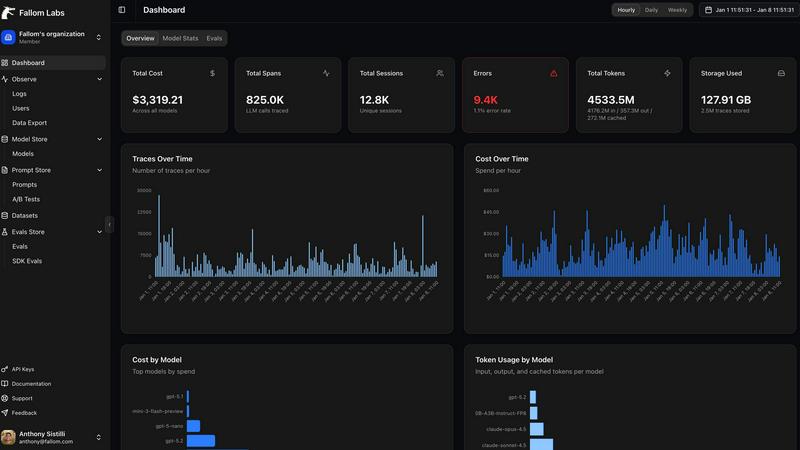
Fallom provides real-time observability and cost tracking for your LLM applications.
Last updated: February 28, 2026
Visual Comparison
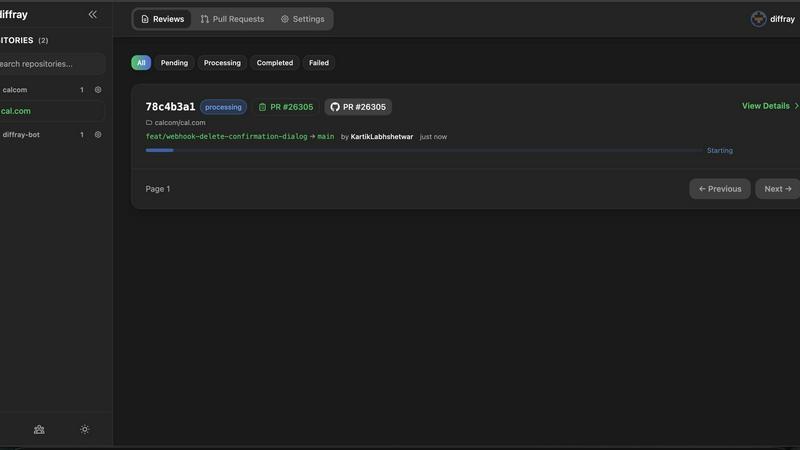
diffray
Fallom
Feature Comparison
diffray
Multi-Agent Specialized Architecture
Unlike monolithic AI tools, diffray employs a team of over 30 specialized AI agents, each trained for a specific domain like security, performance, or bug detection. This ensures expert-level analysis in every category, moving beyond the generalized and often shallow feedback of single-model systems to provide deeply insightful, context-aware reviews.
Full Codebase Context Awareness
diffray progresses beyond simply analyzing the changed lines of code. Its agents intelligently examine the pull request within the full context of your repository, understanding how new code interacts with existing structures, dependencies, and patterns. This prevents misleading out-of-context suggestions and drastically reduces false positives.
Noise Reduction & High-Signal Feedback
By leveraging domain-specific agents and deep context, diffray filters out the irrelevant "noise" that plagues other AI reviewers. It focuses developer attention exclusively on genuine, actionable issues—from critical security flaws to subtle performance anti-patterns—fostering trust and ensuring reviews are acted upon.
Integrated Best Practices & SEO Analysis
diffray's expertise extends beyond bugs to include code quality and business impact. Specialized agents enforce language and framework-specific best practices for maintainability, while unique SEO-focused agents can analyze web-centric code for common issues that might impact search engine visibility, covering a complete quality spectrum.
Fallom
End-to-End LLM Tracing
Fallom provides complete, OpenTelemetry-native tracing for every LLM call and agent action. This goes beyond simple logging to deliver a visual, interconnected map of your AI workflows. You can see the exact sequence of events, from the initial user prompt through intermediate tool calls and reasoning steps to the final response. This granular visibility is essential for debugging complex issues, understanding the "why" behind an agent's behavior, and optimizing the entire chain for performance and cost-efficiency.
Real-Time Cost Attribution & Analytics
Gain precise financial control over your AI spend with Fallom's detailed cost attribution engine. The platform automatically breaks down expenses by model, individual API call, user, team, or even specific customer sessions. This transparency is crucial for teams progressing from project-based budgets to company-wide AI rollouts, enabling accurate chargebacks, forecasting, and identifying optimization opportunities to ensure your AI investment delivers maximum return.
Compliance-Ready Audit Trails
Built for regulated industries, Fallom ensures your AI operations evolve without compliance risk. It maintains immutable, detailed audit logs of every interaction, including full input/output logging, model versioning, and user consent tracking. These features are foundational for adhering to frameworks like the EU AI Act, GDPR, and SOC 2, providing the evidence and control needed to scale AI responsibly and with full accountability.
Advanced Debugging with Tool & Session Context
Debugging agents requires understanding context. Fallom groups related traces into user or customer sessions, providing a holistic view of interactions over time. Furthermore, it offers deep visibility into every tool and function your agents call, displaying arguments and results in detail. This combination of session-level context and tool call visibility turns debugging from a frustrating hunt into a streamlined, efficient process.
Use Cases
diffray
Accelerating Pull Request Workflows for Engineering Teams
Development teams use diffray to automate the initial, labor-intensive pass of code review. By providing immediate, high-quality feedback as soon as a PR is opened, it allows human reviewers to focus on higher-level architecture and logic, significantly speeding up merge times and increasing overall team productivity.
Enforcing Security and Compliance Standards
Security-conscious organizations integrate diffray into their CI/CD pipeline to act as a first-line automated defense. Its dedicated security agents continuously scan every commit for vulnerabilities like injection flaws, insecure dependencies, and secret leakage, helping teams maintain robust security postures and comply with internal policies.
Onboarding and Upskilling Junior Developers
diffray serves as an always-available mentor for junior developers or engineers new to a codebase. By providing instant, educational feedback on best practices, common pitfalls, and project-specific patterns, it accelerates the learning curve and helps cultivate higher code quality standards across the entire team.
Maintaining Code Quality in Legacy or Large-Scale Projects
For teams managing large, complex, or legacy repositories, diffray provides consistent, context-aware analysis that is difficult for humans to maintain. It helps identify brittle code, performance degradation, and deviations from established patterns during refactoring or feature addition, ensuring long-term health.
Fallom
Scaling Enterprise AI Agent Deployments
For enterprises transitioning AI agents from pilot programs to core business operations, Fallom provides the operational backbone. It allows platform teams to monitor the health, performance, and cost of hundreds of concurrent agent workflows, ensuring reliability for end-users and providing the data needed to justify further investment and expansion of AI capabilities across the organization.
Optimizing Cost and Performance of LLM Workloads
Development teams use Fallom to move from a "set and forget" model deployment to a continuous optimization cycle. By analyzing latency waterfalls, token usage patterns, and cost-per-call data, engineers can experiment with different models, prompt structures, and architectures. This data-driven approach leads to faster, cheaper, and more reliable AI features, directly improving the product's bottom line and user experience.
Ensuring Regulatory Compliance for AI Applications
Companies in finance, healthcare, or legal services use Fallom to build and audit compliant AI applications. The platform's detailed audit trails, consent tracking, and privacy controls provide the necessary documentation for internal reviews and external regulators. This enables these companies to innovate with AI while systematically managing risk and upholding their legal and ethical obligations.
Improving Customer Support with AI Analytics
Product and customer success teams leverage Fallom's session tracking and customer analytics to understand how users interact with AI features. They can identify power users, spot common failure points in conversations, and attribute support costs to specific clients. These insights guide product improvements, training data collection, and customer-specific model fine-tuning, evolving the AI from a generic tool to a tailored asset.
Overview
About diffray
diffray marks the next evolutionary stage in AI-powered code review, moving teams beyond the foundational but often frustrating phase of generic, single-model tools. It is engineered for development teams who have experienced the growing pains of early AI reviewers—tools that generate excessive noise, miss critical context, and ultimately erode developer trust. Recognizing that code quality is a multi-faceted challenge, diffray introduces a sophisticated multi-agent architecture. This system deploys a dedicated team of over 30 specialized AI agents, each an expert in a critical domain such as security vulnerability detection, performance optimization, bug prediction, language-specific best practices, and even SEO for relevant codebases. This division of labor allows for a depth of analysis previously unattainable. Instead of a superficial glance at the diff, these agents work in concert to understand the full context of your pull request within the broader codebase. The result is a transformative leap in precision: a dramatic reduction in false-positive alerts and a substantial increase in catching genuine, high-priority issues. diffray evolves code review from a manual, time-consuming chore into a powerful, automated asset. It empowers developers to ship with confidence, elevates overall code quality, and accelerates team velocity by turning review time into saved time.
About Fallom
Fallom represents the next evolutionary stage in AI operations, an observability platform built from the ground up for the age of intelligent agents. It is designed for AI developers and enterprise teams who have moved beyond initial experimentation and are now scaling complex LLM and agent workloads in production. As these systems grow from simple prompts to intricate, multi-step workflows involving tools, databases, and conditional logic, traditional monitoring tools fall short. Fallom fills this critical gap by providing a comprehensive, real-time window into every LLM interaction. It captures the full spectrum of data—prompts, outputs, tool calls, token usage, latency, and costs—transforming opaque AI operations into a transparent, manageable, and optimizable system. Its core value proposition is enabling businesses to progress from merely deploying AI to mastering it, ensuring reliability, controlling spend, and maintaining compliance as their AI initiatives mature and evolve.
Frequently Asked Questions
diffray FAQ
How is diffray different from other AI code review tools?
diffray moves beyond the one-size-fits-all model. Instead of a single AI making all judgments, it uses a multi-agent system where over 30 specialized experts (for security, performance, etc.) analyze your code independently. This, combined with full codebase context, leads to far more accurate, relevant, and actionable feedback with fewer false alarms.
Does diffray integrate with our existing development tools?
Yes, diffray is designed to integrate seamlessly into modern development workflows. It typically connects with popular platforms like GitHub, GitLab, and Bitbucket, operating directly within your pull request interface. It can also be incorporated into CI/CD pipelines for automated gating and quality checks.
How does diffray handle the privacy and security of our code?
diffray is built with enterprise-grade security in mind. Reputable tools in this space operate under strict data handling policies, often processing code in a secure, isolated environment and not storing your source code permanently. You should review diffray's specific security documentation and compliance certifications for detailed assurances.
Can we customize the rules or focus areas for our projects?
Advanced AI review platforms like diffray often provide configuration options to tailor their focus. This can include enabling/disabling specific agent categories (e.g., tuning down SEO for a backend service), defining custom rules, or adjusting severity thresholds to match your team's specific standards and risk tolerance.
Fallom FAQ
How quickly can I integrate Fallom into my existing application?
Integration is designed for rapid progression from setup to insight. With its single, OpenTelemetry-native SDK, you can typically instrument your LLM calls and start seeing traces in your Fallom dashboard in under five minutes. The platform works alongside your existing code, requiring minimal changes to begin collecting comprehensive observability data.
Does Fallom support all major LLM providers?
Yes, Fallom is built on open standards to prevent vendor lock-in and support your AI evolution. It is compatible with all major LLM providers, including OpenAI, Anthropic, Google Gemini, and open-source models. This means you can use a unified observability platform regardless of how your model strategy changes or expands over time.
How does Fallom handle sensitive or private user data?
Fallom includes enterprise-grade privacy controls for regulated environments. You can enable Privacy Mode, which allows you to capture full telemetry and trace data while redacting or disabling the logging of actual prompt and response content. This lets you maintain operational visibility and compliance auditing without storing sensitive information.
Can I use Fallom for testing and evaluating my LLM prompts?
Absolutely. Fallom includes features for running evaluations on LLM outputs, allowing you to track metrics like accuracy, relevance, and hallucination rates. Coupled with its Prompt Store for version control and A/B testing, it creates a robust framework for continuously improving your prompts and catching regressions before they impact production users.
Alternatives
diffray Alternatives
diffray is a specialized AI code review tool designed for development teams. It belongs to the category of advanced developer tools that aim to automate and enhance the code quality process, moving beyond basic linting to provide deep, contextual analysis. Users often explore alternatives for various reasons, including budget constraints, specific integration needs with their existing tech stack, or a desire for different feature sets like real-time collaboration or support for niche programming languages. The search for the right tool is a natural part of a team's growth as their codebase complexity and quality standards evolve. When evaluating options, it's crucial to look beyond surface-level claims. Key considerations should include the tool's underlying analysis methodology, its ability to understand your project's full context to reduce false alarms, and the specialization of its feedback. The goal is to find a solution that developers trust and that genuinely accelerates development velocity by catching real issues.
Fallom Alternatives
Fallom is an AI-native observability platform in the development and monitoring category. It provides real-time tracking, debugging, and cost transparency for large language model and AI agent workloads, helping teams optimize performance and ensure compliance. Users often explore alternatives for various reasons. These can include budget constraints, the need for a different feature set, or specific platform integration requirements that better align with their existing tech stack and operational maturity. When evaluating an alternative, consider your current and future needs. Key factors include the depth of observability for LLM calls, the clarity of cost attribution across teams, built-in compliance features for audit trails, and the ease of implementation with your current development workflow.