
diffray vs HookMesh
Side-by-side comparison to help you choose the right tool.

diffray
Diffray's AI evolves code review to catch real bugs with far fewer false positives.
Last updated: February 28, 2026

HookMesh simplifies webhook delivery with reliable automation, retries, and a self-service portal for seamless.
Last updated: February 28, 2026
Visual Comparison
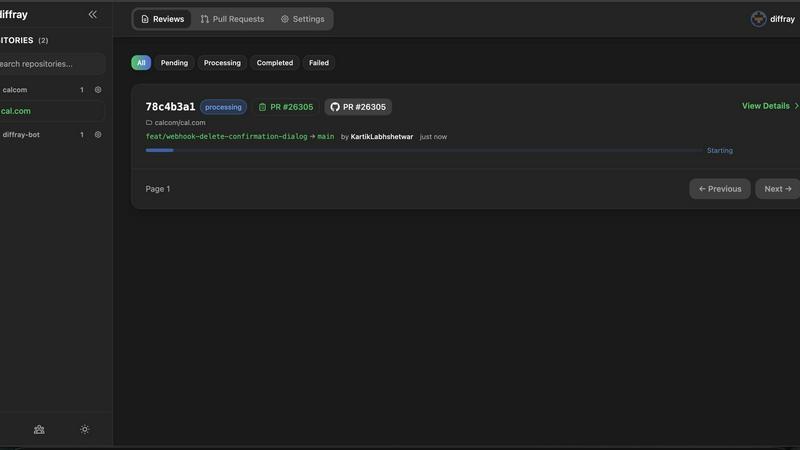
diffray
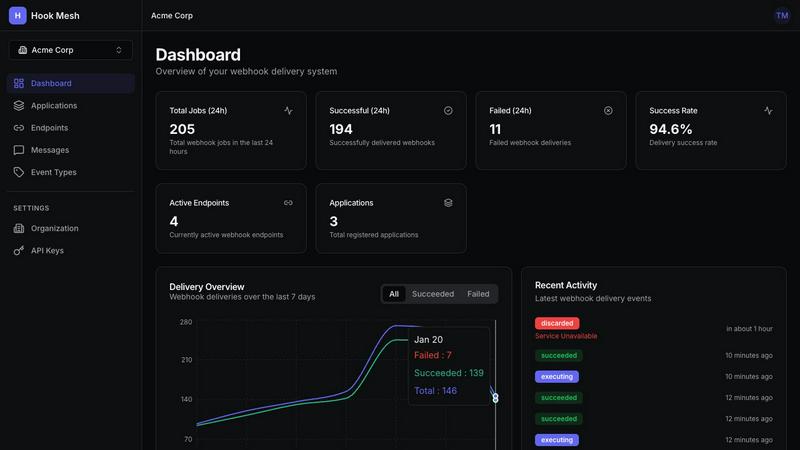
HookMesh
Feature Comparison
diffray
Multi-Agent Specialized Architecture
Unlike monolithic AI tools, diffray employs a team of over 30 specialized AI agents, each trained for a specific domain like security, performance, or bug detection. This ensures expert-level analysis in every category, moving beyond the generalized and often shallow feedback of single-model systems to provide deeply insightful, context-aware reviews.
Full Codebase Context Awareness
diffray progresses beyond simply analyzing the changed lines of code. Its agents intelligently examine the pull request within the full context of your repository, understanding how new code interacts with existing structures, dependencies, and patterns. This prevents misleading out-of-context suggestions and drastically reduces false positives.
Noise Reduction & High-Signal Feedback
By leveraging domain-specific agents and deep context, diffray filters out the irrelevant "noise" that plagues other AI reviewers. It focuses developer attention exclusively on genuine, actionable issues—from critical security flaws to subtle performance anti-patterns—fostering trust and ensuring reviews are acted upon.
Integrated Best Practices & SEO Analysis
diffray's expertise extends beyond bugs to include code quality and business impact. Specialized agents enforce language and framework-specific best practices for maintainability, while unique SEO-focused agents can analyze web-centric code for common issues that might impact search engine visibility, covering a complete quality spectrum.
HookMesh
Reliable Delivery
HookMesh guarantees that webhook events are never lost. With automatic retries, it implements an exponential backoff strategy that intelligently spaces out retries over a period of up to 48 hours. This ensures that even in the face of temporary failures, your webhook messages are persistently sent until confirmed as received.
Circuit Breaker
The circuit breaker feature automatically disables failing endpoints to prevent them from clogging your webhook delivery queue. Once the issue is resolved, the endpoint can be re-enabled seamlessly. This proactive approach minimizes the risk of downtime affecting your entire system, allowing for more stable operations.
Customer Portal
HookMesh includes a self-service portal that empowers your customers to manage their webhook endpoints independently. This embeddable UI allows users to add new endpoints, review delivery logs for transparency, and replay failed deliveries with just a click. Such functionality enhances user experience and reduces the support burden on your team.
Developer Experience
Designed for a seamless developer experience, HookMesh offers a comprehensive REST API and official SDKs for JavaScript, Python, and Go. Developers can integrate webhook functionality in minutes with just a few lines of code. This simplicity accelerates deployment and allows teams to focus on product enhancements rather than technical hurdles.
Use Cases
diffray
Accelerating Pull Request Workflows for Engineering Teams
Development teams use diffray to automate the initial, labor-intensive pass of code review. By providing immediate, high-quality feedback as soon as a PR is opened, it allows human reviewers to focus on higher-level architecture and logic, significantly speeding up merge times and increasing overall team productivity.
Enforcing Security and Compliance Standards
Security-conscious organizations integrate diffray into their CI/CD pipeline to act as a first-line automated defense. Its dedicated security agents continuously scan every commit for vulnerabilities like injection flaws, insecure dependencies, and secret leakage, helping teams maintain robust security postures and comply with internal policies.
Onboarding and Upskilling Junior Developers
diffray serves as an always-available mentor for junior developers or engineers new to a codebase. By providing instant, educational feedback on best practices, common pitfalls, and project-specific patterns, it accelerates the learning curve and helps cultivate higher code quality standards across the entire team.
Maintaining Code Quality in Legacy or Large-Scale Projects
For teams managing large, complex, or legacy repositories, diffray provides consistent, context-aware analysis that is difficult for humans to maintain. It helps identify brittle code, performance degradation, and deviations from established patterns during refactoring or feature addition, ensuring long-term health.
HookMesh
E-commerce Transactions
In the e-commerce sector, businesses can leverage HookMesh to reliably send order notifications and transaction updates to customer endpoints. This ensures customers receive timely information about their orders, which is crucial for enhancing customer satisfaction and retention.
SaaS Integration
SaaS platforms can utilize HookMesh to facilitate integrations with third-party services by delivering real-time event notifications. This capability allows for a more cohesive user experience and helps maintain data synchronization across different applications, improving overall functionality.
Marketing Automation
Marketing teams can use HookMesh to manage webhook deliveries for campaign triggers, such as customer sign-ups or abandoned cart reminders. By ensuring reliable and timely notifications, businesses can enhance their marketing effectiveness and engagement rates.
System Health Monitoring
Organizations can set up HookMesh to send alerts to their systems when certain thresholds are met or anomalies detected. This proactive monitoring allows teams to respond quickly to potential issues, thereby reducing downtime and improving operational reliability.
Overview
About diffray
diffray marks the next evolutionary stage in AI-powered code review, moving teams beyond the foundational but often frustrating phase of generic, single-model tools. It is engineered for development teams who have experienced the growing pains of early AI reviewers—tools that generate excessive noise, miss critical context, and ultimately erode developer trust. Recognizing that code quality is a multi-faceted challenge, diffray introduces a sophisticated multi-agent architecture. This system deploys a dedicated team of over 30 specialized AI agents, each an expert in a critical domain such as security vulnerability detection, performance optimization, bug prediction, language-specific best practices, and even SEO for relevant codebases. This division of labor allows for a depth of analysis previously unattainable. Instead of a superficial glance at the diff, these agents work in concert to understand the full context of your pull request within the broader codebase. The result is a transformative leap in precision: a dramatic reduction in false-positive alerts and a substantial increase in catching genuine, high-priority issues. diffray evolves code review from a manual, time-consuming chore into a powerful, automated asset. It empowers developers to ship with confidence, elevates overall code quality, and accelerates team velocity by turning review time into saved time.
About HookMesh
HookMesh is a cutting-edge solution designed to streamline and optimize webhook delivery for contemporary SaaS products. In a world where seamless data communication is key, HookMesh alleviates the burdens associated with in-house webhook creation and management. Common challenges like implementing retry logic, configuring circuit breakers, and troubleshooting delivery failures can divert focus from core product development. With HookMesh, businesses can shift their attention back to innovation and growth, while relying on a robust platform that guarantees dependable webhook delivery. This solution employs battle-tested infrastructure that ensures events are delivered reliably through features like automatic retries, exponential backoff, and idempotency keys. HookMesh empowers developers and product teams to provide a flawless user experience, ensuring webhook events are consistently and reliably delivered. Moreover, the self-service portal enhances customer autonomy, enabling users to manage endpoints and effortlessly replay failed webhooks, making HookMesh an essential tool for organizations seeking to enhance their webhook strategy and operational efficiency.
Frequently Asked Questions
diffray FAQ
How is diffray different from other AI code review tools?
diffray moves beyond the one-size-fits-all model. Instead of a single AI making all judgments, it uses a multi-agent system where over 30 specialized experts (for security, performance, etc.) analyze your code independently. This, combined with full codebase context, leads to far more accurate, relevant, and actionable feedback with fewer false alarms.
Does diffray integrate with our existing development tools?
Yes, diffray is designed to integrate seamlessly into modern development workflows. It typically connects with popular platforms like GitHub, GitLab, and Bitbucket, operating directly within your pull request interface. It can also be incorporated into CI/CD pipelines for automated gating and quality checks.
How does diffray handle the privacy and security of our code?
diffray is built with enterprise-grade security in mind. Reputable tools in this space operate under strict data handling policies, often processing code in a secure, isolated environment and not storing your source code permanently. You should review diffray's specific security documentation and compliance certifications for detailed assurances.
Can we customize the rules or focus areas for our projects?
Advanced AI review platforms like diffray often provide configuration options to tailor their focus. This can include enabling/disabling specific agent categories (e.g., tuning down SEO for a backend service), defining custom rules, or adjusting severity thresholds to match your team's specific standards and risk tolerance.
HookMesh FAQ
What types of payloads can I send with HookMesh?
HookMesh accepts any JSON payload, allowing for flexible data structures tailored to your application's needs. This versatility ensures that you can send the necessary information without limitations.
How does the automatic retry feature work?
The automatic retry feature employs an exponential backoff strategy with jitter, retrying failed webhook deliveries for up to 48 hours. This means that if a delivery fails, it will intelligently space out subsequent attempts to mitigate server overload and increase the chances of successful delivery.
Is there a limit on the number of endpoints I can create?
HookMesh allows for unlimited endpoint management, but specific pricing tiers may determine the number of webhook messages you can send monthly. The self-service portal enables you to manage these endpoints effortlessly.
Can I test webhooks before going live?
Yes, HookMesh provides a playground feature that allows developers to test and debug webhooks prior to deploying them in a production environment. This ensures that your webhook events function as intended, reducing the risk of errors post-launch.
Alternatives
diffray Alternatives
diffray is a specialized AI code review tool designed for development teams. It belongs to the category of advanced developer tools that aim to automate and enhance the code quality process, moving beyond basic linting to provide deep, contextual analysis. Users often explore alternatives for various reasons, including budget constraints, specific integration needs with their existing tech stack, or a desire for different feature sets like real-time collaboration or support for niche programming languages. The search for the right tool is a natural part of a team's growth as their codebase complexity and quality standards evolve. When evaluating options, it's crucial to look beyond surface-level claims. Key considerations should include the tool's underlying analysis methodology, its ability to understand your project's full context to reduce false alarms, and the specialization of its feedback. The goal is to find a solution that developers trust and that genuinely accelerates development velocity by catching real issues.
HookMesh Alternatives
HookMesh is a cutting-edge solution designed to streamline webhook delivery for modern SaaS applications. By addressing the complexities of building and managing webhooks in-house, it enables developers and product teams to focus on core functionalities while ensuring reliable event delivery. As businesses evolve, users may seek alternatives to HookMesh for various reasons, including pricing, feature sets, or specific platform needs that better align with their operational goals. When choosing an alternative, it is essential to consider factors such as the reliability of delivery mechanisms, ease of use, customer support availability, and integration capabilities. A well-rounded solution should offer features that enhance the user experience, ensuring that webhook management is seamless and efficient, regardless of the chosen platform.