
Fallom vs HookMesh
Side-by-side comparison to help you choose the right tool.

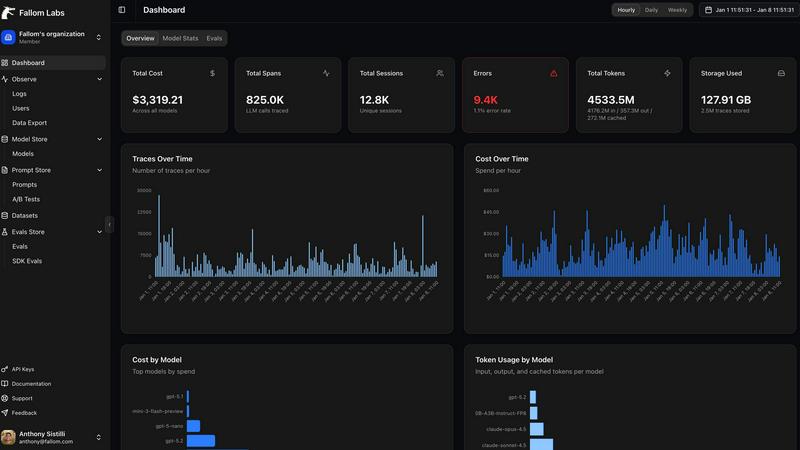
Fallom provides real-time observability and cost tracking for your LLM applications.
Last updated: February 28, 2026

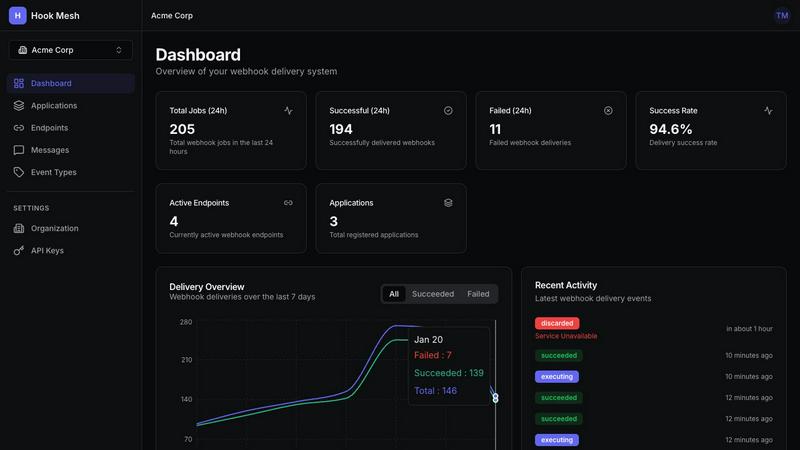
HookMesh simplifies webhook delivery with reliable automation, retries, and a self-service portal for seamless.
Last updated: February 28, 2026
Visual Comparison
Fallom
HookMesh
Feature Comparison
Fallom
End-to-End LLM Tracing
Fallom provides complete, OpenTelemetry-native tracing for every LLM call and agent action. This goes beyond simple logging to deliver a visual, interconnected map of your AI workflows. You can see the exact sequence of events, from the initial user prompt through intermediate tool calls and reasoning steps to the final response. This granular visibility is essential for debugging complex issues, understanding the "why" behind an agent's behavior, and optimizing the entire chain for performance and cost-efficiency.
Real-Time Cost Attribution & Analytics
Gain precise financial control over your AI spend with Fallom's detailed cost attribution engine. The platform automatically breaks down expenses by model, individual API call, user, team, or even specific customer sessions. This transparency is crucial for teams progressing from project-based budgets to company-wide AI rollouts, enabling accurate chargebacks, forecasting, and identifying optimization opportunities to ensure your AI investment delivers maximum return.
Compliance-Ready Audit Trails
Built for regulated industries, Fallom ensures your AI operations evolve without compliance risk. It maintains immutable, detailed audit logs of every interaction, including full input/output logging, model versioning, and user consent tracking. These features are foundational for adhering to frameworks like the EU AI Act, GDPR, and SOC 2, providing the evidence and control needed to scale AI responsibly and with full accountability.
Advanced Debugging with Tool & Session Context
Debugging agents requires understanding context. Fallom groups related traces into user or customer sessions, providing a holistic view of interactions over time. Furthermore, it offers deep visibility into every tool and function your agents call, displaying arguments and results in detail. This combination of session-level context and tool call visibility turns debugging from a frustrating hunt into a streamlined, efficient process.
HookMesh
Reliable Delivery
HookMesh guarantees that webhook events are never lost. With automatic retries, it implements an exponential backoff strategy that intelligently spaces out retries over a period of up to 48 hours. This ensures that even in the face of temporary failures, your webhook messages are persistently sent until confirmed as received.
Circuit Breaker
The circuit breaker feature automatically disables failing endpoints to prevent them from clogging your webhook delivery queue. Once the issue is resolved, the endpoint can be re-enabled seamlessly. This proactive approach minimizes the risk of downtime affecting your entire system, allowing for more stable operations.
Customer Portal
HookMesh includes a self-service portal that empowers your customers to manage their webhook endpoints independently. This embeddable UI allows users to add new endpoints, review delivery logs for transparency, and replay failed deliveries with just a click. Such functionality enhances user experience and reduces the support burden on your team.
Developer Experience
Designed for a seamless developer experience, HookMesh offers a comprehensive REST API and official SDKs for JavaScript, Python, and Go. Developers can integrate webhook functionality in minutes with just a few lines of code. This simplicity accelerates deployment and allows teams to focus on product enhancements rather than technical hurdles.
Use Cases
Fallom
Scaling Enterprise AI Agent Deployments
For enterprises transitioning AI agents from pilot programs to core business operations, Fallom provides the operational backbone. It allows platform teams to monitor the health, performance, and cost of hundreds of concurrent agent workflows, ensuring reliability for end-users and providing the data needed to justify further investment and expansion of AI capabilities across the organization.
Optimizing Cost and Performance of LLM Workloads
Development teams use Fallom to move from a "set and forget" model deployment to a continuous optimization cycle. By analyzing latency waterfalls, token usage patterns, and cost-per-call data, engineers can experiment with different models, prompt structures, and architectures. This data-driven approach leads to faster, cheaper, and more reliable AI features, directly improving the product's bottom line and user experience.
Ensuring Regulatory Compliance for AI Applications
Companies in finance, healthcare, or legal services use Fallom to build and audit compliant AI applications. The platform's detailed audit trails, consent tracking, and privacy controls provide the necessary documentation for internal reviews and external regulators. This enables these companies to innovate with AI while systematically managing risk and upholding their legal and ethical obligations.
Improving Customer Support with AI Analytics
Product and customer success teams leverage Fallom's session tracking and customer analytics to understand how users interact with AI features. They can identify power users, spot common failure points in conversations, and attribute support costs to specific clients. These insights guide product improvements, training data collection, and customer-specific model fine-tuning, evolving the AI from a generic tool to a tailored asset.
HookMesh
E-commerce Transactions
In the e-commerce sector, businesses can leverage HookMesh to reliably send order notifications and transaction updates to customer endpoints. This ensures customers receive timely information about their orders, which is crucial for enhancing customer satisfaction and retention.
SaaS Integration
SaaS platforms can utilize HookMesh to facilitate integrations with third-party services by delivering real-time event notifications. This capability allows for a more cohesive user experience and helps maintain data synchronization across different applications, improving overall functionality.
Marketing Automation
Marketing teams can use HookMesh to manage webhook deliveries for campaign triggers, such as customer sign-ups or abandoned cart reminders. By ensuring reliable and timely notifications, businesses can enhance their marketing effectiveness and engagement rates.
System Health Monitoring
Organizations can set up HookMesh to send alerts to their systems when certain thresholds are met or anomalies detected. This proactive monitoring allows teams to respond quickly to potential issues, thereby reducing downtime and improving operational reliability.
Overview
About Fallom
Fallom represents the next evolutionary stage in AI operations, an observability platform built from the ground up for the age of intelligent agents. It is designed for AI developers and enterprise teams who have moved beyond initial experimentation and are now scaling complex LLM and agent workloads in production. As these systems grow from simple prompts to intricate, multi-step workflows involving tools, databases, and conditional logic, traditional monitoring tools fall short. Fallom fills this critical gap by providing a comprehensive, real-time window into every LLM interaction. It captures the full spectrum of data—prompts, outputs, tool calls, token usage, latency, and costs—transforming opaque AI operations into a transparent, manageable, and optimizable system. Its core value proposition is enabling businesses to progress from merely deploying AI to mastering it, ensuring reliability, controlling spend, and maintaining compliance as their AI initiatives mature and evolve.
About HookMesh
HookMesh is a cutting-edge solution designed to streamline and optimize webhook delivery for contemporary SaaS products. In a world where seamless data communication is key, HookMesh alleviates the burdens associated with in-house webhook creation and management. Common challenges like implementing retry logic, configuring circuit breakers, and troubleshooting delivery failures can divert focus from core product development. With HookMesh, businesses can shift their attention back to innovation and growth, while relying on a robust platform that guarantees dependable webhook delivery. This solution employs battle-tested infrastructure that ensures events are delivered reliably through features like automatic retries, exponential backoff, and idempotency keys. HookMesh empowers developers and product teams to provide a flawless user experience, ensuring webhook events are consistently and reliably delivered. Moreover, the self-service portal enhances customer autonomy, enabling users to manage endpoints and effortlessly replay failed webhooks, making HookMesh an essential tool for organizations seeking to enhance their webhook strategy and operational efficiency.
Frequently Asked Questions
Fallom FAQ
How quickly can I integrate Fallom into my existing application?
Integration is designed for rapid progression from setup to insight. With its single, OpenTelemetry-native SDK, you can typically instrument your LLM calls and start seeing traces in your Fallom dashboard in under five minutes. The platform works alongside your existing code, requiring minimal changes to begin collecting comprehensive observability data.
Does Fallom support all major LLM providers?
Yes, Fallom is built on open standards to prevent vendor lock-in and support your AI evolution. It is compatible with all major LLM providers, including OpenAI, Anthropic, Google Gemini, and open-source models. This means you can use a unified observability platform regardless of how your model strategy changes or expands over time.
How does Fallom handle sensitive or private user data?
Fallom includes enterprise-grade privacy controls for regulated environments. You can enable Privacy Mode, which allows you to capture full telemetry and trace data while redacting or disabling the logging of actual prompt and response content. This lets you maintain operational visibility and compliance auditing without storing sensitive information.
Can I use Fallom for testing and evaluating my LLM prompts?
Absolutely. Fallom includes features for running evaluations on LLM outputs, allowing you to track metrics like accuracy, relevance, and hallucination rates. Coupled with its Prompt Store for version control and A/B testing, it creates a robust framework for continuously improving your prompts and catching regressions before they impact production users.
HookMesh FAQ
What types of payloads can I send with HookMesh?
HookMesh accepts any JSON payload, allowing for flexible data structures tailored to your application's needs. This versatility ensures that you can send the necessary information without limitations.
How does the automatic retry feature work?
The automatic retry feature employs an exponential backoff strategy with jitter, retrying failed webhook deliveries for up to 48 hours. This means that if a delivery fails, it will intelligently space out subsequent attempts to mitigate server overload and increase the chances of successful delivery.
Is there a limit on the number of endpoints I can create?
HookMesh allows for unlimited endpoint management, but specific pricing tiers may determine the number of webhook messages you can send monthly. The self-service portal enables you to manage these endpoints effortlessly.
Can I test webhooks before going live?
Yes, HookMesh provides a playground feature that allows developers to test and debug webhooks prior to deploying them in a production environment. This ensures that your webhook events function as intended, reducing the risk of errors post-launch.
Alternatives
Fallom Alternatives
Fallom is an AI-native observability platform in the development and monitoring category. It provides real-time tracking, debugging, and cost transparency for large language model and AI agent workloads, helping teams optimize performance and ensure compliance. Users often explore alternatives for various reasons. These can include budget constraints, the need for a different feature set, or specific platform integration requirements that better align with their existing tech stack and operational maturity. When evaluating an alternative, consider your current and future needs. Key factors include the depth of observability for LLM calls, the clarity of cost attribution across teams, built-in compliance features for audit trails, and the ease of implementation with your current development workflow.
HookMesh Alternatives
HookMesh is a cutting-edge solution designed to streamline webhook delivery for modern SaaS applications. By addressing the complexities of building and managing webhooks in-house, it enables developers and product teams to focus on core functionalities while ensuring reliable event delivery. As businesses evolve, users may seek alternatives to HookMesh for various reasons, including pricing, feature sets, or specific platform needs that better align with their operational goals. When choosing an alternative, it is essential to consider factors such as the reliability of delivery mechanisms, ease of use, customer support availability, and integration capabilities. A well-rounded solution should offer features that enhance the user experience, ensuring that webhook management is seamless and efficient, regardless of the chosen platform.