
HookMesh vs Mod
Side-by-side comparison to help you choose the right tool.

HookMesh simplifies webhook delivery with reliable automation, retries, and a self-service portal for seamless.
Last updated: February 28, 2026

Mod evolves from a CSS framework into a complete component library for shipping SaaS UI faster.
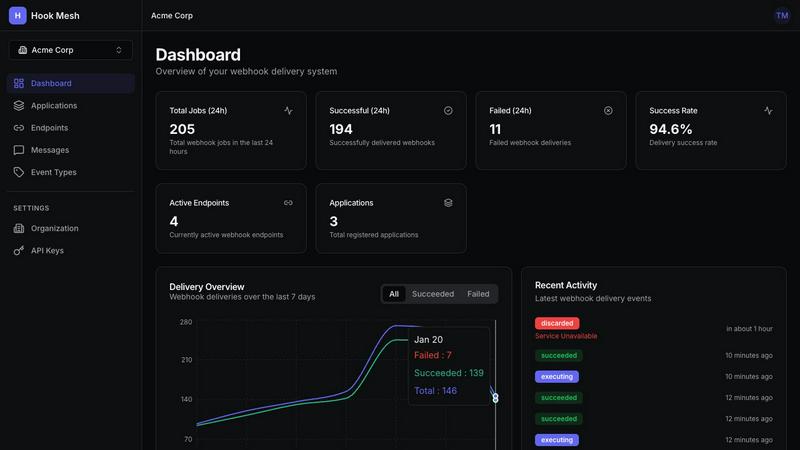
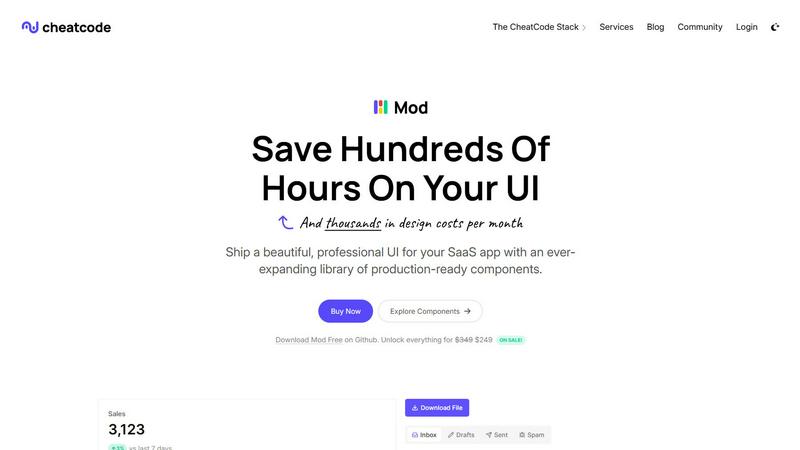
Visual Comparison
HookMesh
Mod
Feature Comparison
HookMesh
Reliable Delivery
HookMesh guarantees that webhook events are never lost. With automatic retries, it implements an exponential backoff strategy that intelligently spaces out retries over a period of up to 48 hours. This ensures that even in the face of temporary failures, your webhook messages are persistently sent until confirmed as received.
Circuit Breaker
The circuit breaker feature automatically disables failing endpoints to prevent them from clogging your webhook delivery queue. Once the issue is resolved, the endpoint can be re-enabled seamlessly. This proactive approach minimizes the risk of downtime affecting your entire system, allowing for more stable operations.
Customer Portal
HookMesh includes a self-service portal that empowers your customers to manage their webhook endpoints independently. This embeddable UI allows users to add new endpoints, review delivery logs for transparency, and replay failed deliveries with just a click. Such functionality enhances user experience and reduces the support burden on your team.
Developer Experience
Designed for a seamless developer experience, HookMesh offers a comprehensive REST API and official SDKs for JavaScript, Python, and Go. Developers can integrate webhook functionality in minutes with just a few lines of code. This simplicity accelerates deployment and allows teams to focus on product enhancements rather than technical hurdles.
Mod
Expansive Component Library
Mod provides an extensive collection of over 88 meticulously designed components that form the building blocks of any SaaS application. This includes everything from complex data tables, modals, and navigation bars to form elements, alerts, and pricing cards. Each component is built with accessibility and semantic HTML in mind, ensuring a solid foundation. This library allows developers to assemble sophisticated user interfaces without starting from scratch, ensuring consistency and professional polish across every page and feature of your application.
Deep Customization with Design Tokens
Beyond pre-built components, Mod offers profound customization through 168 distinct styles and a comprehensive system of design tokens. This includes spacing scales, color palettes, typography rules, and shadow elevations. You can theme your entire application by modifying these central tokens, and changes propagate automatically across all components. This system provides the flexibility to match your brand identity perfectly while maintaining the underlying consistency and quality of the Mod framework, scaling your design system as your product grows.
Framework-Agnostic & Lightweight Integration
Mod is engineered to work seamlessly within any modern tech stack. It delivers pure, utility-first CSS that can be imported into projects using Next.js, Nuxt, Vite, Svelte, Ruby on Rails, Django, and more. There is no heavy JavaScript runtime or proprietary syntax to learn; it integrates like any other CSS framework. This agnostic approach future-proofs your investment, allowing you to adopt Mod today and change your underlying application framework tomorrow without rewriting your entire UI layer.
Production-Ready Themes & Icons
The library ships with two complete, professional themes (light and dark) and includes built-in, easy-to-implement dark mode support. Furthermore, it comes bundled with a suite of over 1,500 crisp icons, covering a vast range of common SaaS needs. Having a cohesive icon set and pre-configured themes eliminates the time-consuming search for matching assets and ensures visual harmony. Every element is built with a mobile-first, responsive design philosophy, guaranteeing your application looks and works flawlessly on all devices from the start.
Use Cases
HookMesh
E-commerce Transactions
In the e-commerce sector, businesses can leverage HookMesh to reliably send order notifications and transaction updates to customer endpoints. This ensures customers receive timely information about their orders, which is crucial for enhancing customer satisfaction and retention.
SaaS Integration
SaaS platforms can utilize HookMesh to facilitate integrations with third-party services by delivering real-time event notifications. This capability allows for a more cohesive user experience and helps maintain data synchronization across different applications, improving overall functionality.
Marketing Automation
Marketing teams can use HookMesh to manage webhook deliveries for campaign triggers, such as customer sign-ups or abandoned cart reminders. By ensuring reliable and timely notifications, businesses can enhance their marketing effectiveness and engagement rates.
System Health Monitoring
Organizations can set up HookMesh to send alerts to their systems when certain thresholds are met or anomalies detected. This proactive monitoring allows teams to respond quickly to potential issues, thereby reducing downtime and improving operational reliability.
Mod
Rapid Prototyping and MVP Development
For solo developers and startups, speed is everything. Mod is the perfect tool for rapidly transforming a concept into a tangible, investor-ready minimum viable product (MVP). By leveraging the pre-built components and layouts, you can construct a fully functional, visually compelling prototype in days instead of weeks. This allows you to validate your business idea with real users quickly, gather feedback, and iterate without being blocked by UI development hurdles.
Standardizing UI Across Development Teams
In growing teams, inconsistent UI implementation can slow down development and harm product quality. Mod acts as a single source of truth for the user interface. By adopting Mod, teams ensure that every developer is using the same components, spacing, and colors. This standardization streamlines collaboration, reduces code review time for visual aspects, and ensures that new features feel like a natural part of the existing application, maintaining a professional and unified user experience.
Modernizing Legacy Application UIs
Many established SaaS products suffer from outdated, inconsistent front-end code that is expensive to maintain. Mod provides a strategic path for gradual UI modernization. Teams can incrementally replace old, brittle CSS with Mod's components and utility classes, one section or feature at a time. This approach minimizes risk, allows for continuous deployment, and progressively delivers a fresh, modern, and responsive interface to users without a costly full rewrite.
Building Consistent Internal Tools and Admin Panels
SaaS companies often need to build robust internal dashboards, admin panels, and customer portals. These projects are critical for operations but rarely justify a large design investment. Mod is ideal for this use case, enabling small teams or even a single developer to build powerful, intuitive internal tools that maintain the same level of polish and usability as the customer-facing product, all while staying on budget and schedule.
Overview
About HookMesh
HookMesh is a cutting-edge solution designed to streamline and optimize webhook delivery for contemporary SaaS products. In a world where seamless data communication is key, HookMesh alleviates the burdens associated with in-house webhook creation and management. Common challenges like implementing retry logic, configuring circuit breakers, and troubleshooting delivery failures can divert focus from core product development. With HookMesh, businesses can shift their attention back to innovation and growth, while relying on a robust platform that guarantees dependable webhook delivery. This solution employs battle-tested infrastructure that ensures events are delivered reliably through features like automatic retries, exponential backoff, and idempotency keys. HookMesh empowers developers and product teams to provide a flawless user experience, ensuring webhook events are consistently and reliably delivered. Moreover, the self-service portal enhances customer autonomy, enabling users to manage endpoints and effortlessly replay failed webhooks, making HookMesh an essential tool for organizations seeking to enhance their webhook strategy and operational efficiency.
About Mod
Mod represents a pivotal evolution in the journey of a SaaS developer, transitioning from wrestling with inconsistent, time-consuming UI code to shipping polished, professional applications with confidence and speed. It is a comprehensive CSS framework and component library meticulously crafted for the specific demands of building modern software-as-a-service user interfaces. Designed for solo founders, indie hackers, and development teams, Mod eliminates the traditional design bottleneck. Its core value proposition is acceleration: by providing a vast, production-ready system of visual styles and interactive components, it allows developers to bypass the repetitive groundwork of UI construction. This means you can invest your energy into your unique application logic and user experience, dramatically reducing time-to-market and the costs associated with custom design work. Framework-agnostic by design, Mod seamlessly integrates into your existing workflow, whether you're building with Next.js, SvelteKit, Rails, Django, or any other modern stack. It's not just a set of tools; it's a growth catalyst for your project, enabling you to present a mature, visually cohesive product from the very first commit.
Frequently Asked Questions
HookMesh FAQ
What types of payloads can I send with HookMesh?
HookMesh accepts any JSON payload, allowing for flexible data structures tailored to your application's needs. This versatility ensures that you can send the necessary information without limitations.
How does the automatic retry feature work?
The automatic retry feature employs an exponential backoff strategy with jitter, retrying failed webhook deliveries for up to 48 hours. This means that if a delivery fails, it will intelligently space out subsequent attempts to mitigate server overload and increase the chances of successful delivery.
Is there a limit on the number of endpoints I can create?
HookMesh allows for unlimited endpoint management, but specific pricing tiers may determine the number of webhook messages you can send monthly. The self-service portal enables you to manage these endpoints effortlessly.
Can I test webhooks before going live?
Yes, HookMesh provides a playground feature that allows developers to test and debug webhooks prior to deploying them in a production environment. This ensures that your webhook events function as intended, reducing the risk of errors post-launch.
Mod FAQ
Is Mod a JavaScript library or a CSS framework?
Mod is primarily a CSS framework. It delivers its functionality through CSS classes and design tokens. While its components are demonstrated with HTML structure, there is no bundled JavaScript behavior; you implement interactivity (like opening a modal) using your chosen front-end framework (React, Vue, Svelte, etc.) or vanilla JavaScript. This keeps it lightweight and gives you full control over component logic.
How does Mod handle responsiveness and mobile design?
Mod is built from the ground up with a mobile-first, responsive design philosophy. All components, layout grids, and spacing utilities are designed to adapt gracefully from small mobile screens to large desktop displays. You use responsive modifier classes (e.g., for different breakpoints) to control how elements behave across screen sizes, ensuring your SaaS application delivers an optimal experience on every device without requiring custom media queries for common patterns.
Can I use Mod with my existing project's CSS or other frameworks?
Yes, absolutely. Mod is designed to be incrementally adoptable. You can import its CSS alongside your existing stylesheets. It uses specific, semantic class names to minimize conflicts. A recommended approach is to start using Mod for new features or during a redesign, allowing you to gradually transition your project without disrupting currently working parts of your application.
What is included in the yearly updates mentioned?
The yearly updates ensure your license provides access to new components, features, and improvements released for Mod over a 12-month period. This includes additions to the component library, expansions of the icon set, new theme variations, updates to the design token system, and compatibility enhancements for new versions of major web frameworks. It's a commitment to keeping your toolset current and growing alongside modern web development standards.