
HookMesh vs Hostim.dev
Side-by-side comparison to help you choose the right tool.

HookMesh simplifies webhook delivery with reliable automation, retries, and a self-service portal for seamless.
Last updated: February 28, 2026

Hostim.dev
Hostim.dev evolves your Docker deployment with EU-hosted databases and simple, predictable pricing.
Last updated: March 1, 2026
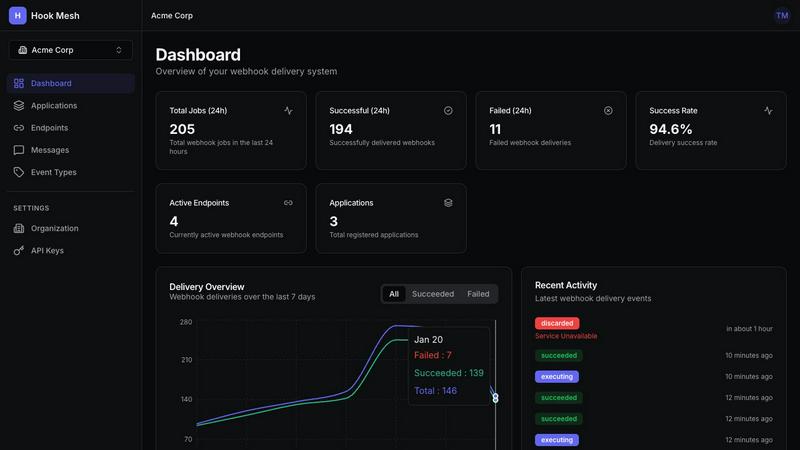
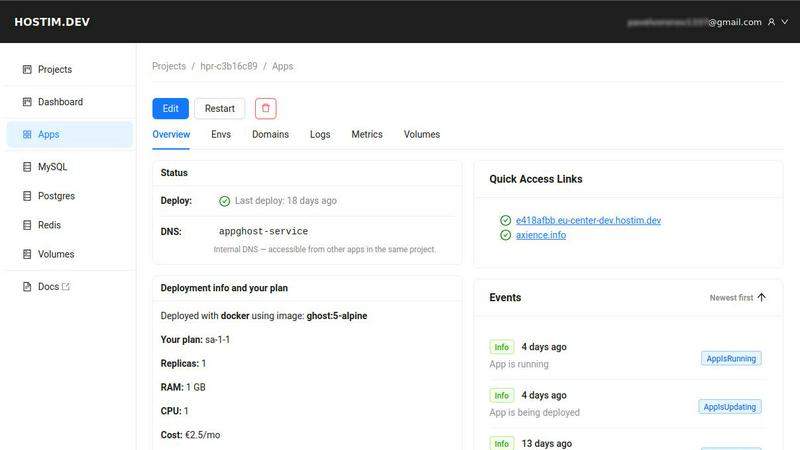
Visual Comparison
HookMesh
Hostim.dev
Feature Comparison
HookMesh
Reliable Delivery
HookMesh guarantees that webhook events are never lost. With automatic retries, it implements an exponential backoff strategy that intelligently spaces out retries over a period of up to 48 hours. This ensures that even in the face of temporary failures, your webhook messages are persistently sent until confirmed as received.
Circuit Breaker
The circuit breaker feature automatically disables failing endpoints to prevent them from clogging your webhook delivery queue. Once the issue is resolved, the endpoint can be re-enabled seamlessly. This proactive approach minimizes the risk of downtime affecting your entire system, allowing for more stable operations.
Customer Portal
HookMesh includes a self-service portal that empowers your customers to manage their webhook endpoints independently. This embeddable UI allows users to add new endpoints, review delivery logs for transparency, and replay failed deliveries with just a click. Such functionality enhances user experience and reduces the support burden on your team.
Developer Experience
Designed for a seamless developer experience, HookMesh offers a comprehensive REST API and official SDKs for JavaScript, Python, and Go. Developers can integrate webhook functionality in minutes with just a few lines of code. This simplicity accelerates deployment and allows teams to focus on product enhancements rather than technical hurdles.
Hostim.dev
Simplified Deployment from Any Source
Hostim.dev accelerates your development lifecycle by accepting deployments from the tools you already use. You can launch applications directly from a public or private Docker image, connect a Git repository for automatic updates, or paste a full Docker Compose file to replicate complex multi-service environments instantly. This flexibility means you can evolve from a simple prototype to a sophisticated microservices architecture without changing your deployment workflow, getting from code to live URL in mere minutes.
Built-in Managed Services & Persistent Storage
Eliminating the need to juggle multiple cloud service dashboards, Hostim.dev automatically provisions and wires essential backend services directly into your project's environment. With one click, you can add production-ready instances of MySQL, PostgreSQL, or Redis, which are seamlessly connected with pre-configured environment variables. Persistent volumes for your application data are equally simple to attach, ensuring your stateful data survives container restarts and updates, all managed within the same intuitive interface.
Per-Project Isolation & Security
Every project on Hostim.dev runs in its own isolated Kubernetes namespace, creating a secure boundary between your different applications or client work. This isolation is foundational for security and operational clarity. Each project benefits from automatic HTTPS via Let's Encrypt, internal private networking, live logs, and basic metrics. This "secure by default" approach means your applications are production-ready from the first deployment, protecting you and your clients from common oversights.
Transparent, Predictable Pricing & EU Hosting
Hostim.dev champions financial clarity with straightforward, per-project hourly billing starting from just €2.50 per month. You can track costs for each client or project individually, making invoicing and budgeting simple. All infrastructure is hosted on bare-metal servers in Germany, ensuring full GDPR compliance by default and low-latency access for European users. This combination of predictable pricing and sovereign data hosting removes the legal and financial uncertainties often associated with larger, more opaque cloud providers.
Use Cases
HookMesh
E-commerce Transactions
In the e-commerce sector, businesses can leverage HookMesh to reliably send order notifications and transaction updates to customer endpoints. This ensures customers receive timely information about their orders, which is crucial for enhancing customer satisfaction and retention.
SaaS Integration
SaaS platforms can utilize HookMesh to facilitate integrations with third-party services by delivering real-time event notifications. This capability allows for a more cohesive user experience and helps maintain data synchronization across different applications, improving overall functionality.
Marketing Automation
Marketing teams can use HookMesh to manage webhook deliveries for campaign triggers, such as customer sign-ups or abandoned cart reminders. By ensuring reliable and timely notifications, businesses can enhance their marketing effectiveness and engagement rates.
System Health Monitoring
Organizations can set up HookMesh to send alerts to their systems when certain thresholds are met or anomalies detected. This proactive monitoring allows teams to respond quickly to potential issues, thereby reducing downtime and improving operational reliability.
Hostim.dev
Freelancers Shipping Client Projects
For freelancers, speed and professionalism are currency. Hostim.dev allows you to deploy a client's web app, API, or full-stack project directly from a Git repo or Compose file, dramatically reducing delivery time. The per-project billing model lets you pass on clear, predictable hosting costs to your client, and the isolated namespace ensures a clean, secure handover when the project is complete, enhancing your reputation for reliable delivery.
Agencies Managing Multiple Client Portfolios
Agencies can leverage Hostim.dev to maintain strict separation between different client projects, each in its own isolated environment. This prevents configuration drift and security risks. The platform provides a clear cost breakdown per project, simplifying internal accounting and client billing. The EU-based, GDPR-compliant hosting is a key selling point for agencies serving European customers who require strict data sovereignty.
Students & Developers Building Portfolios
Aspiring developers need real-world experience with deployment and databases, not just local coding. Hostim.dev's free trial and student-friendly pricing provide a risk-free platform to learn. Students can deploy full-stack applications using real PostgreSQL or MySQL databases, understand environment variables, and work with Docker in a production-like setting, resulting in a live portfolio piece that demonstrates practical, in-demand DevOps-adjacent skills.
Rapid Prototyping & MVP Development
When validating a new startup idea or building a minimum viable product (MVP), infrastructure should not be a bottleneck. Hostim.dev is perfect for this stage: define your app and its database in a Docker Compose file, deploy it in minutes, and share a live link with stakeholders. As the project gains traction, you can seamlessly scale CPU and RAM resources from the UI, allowing your infrastructure to evolve in lockstep with your product's growth.
Overview
About HookMesh
HookMesh is a cutting-edge solution designed to streamline and optimize webhook delivery for contemporary SaaS products. In a world where seamless data communication is key, HookMesh alleviates the burdens associated with in-house webhook creation and management. Common challenges like implementing retry logic, configuring circuit breakers, and troubleshooting delivery failures can divert focus from core product development. With HookMesh, businesses can shift their attention back to innovation and growth, while relying on a robust platform that guarantees dependable webhook delivery. This solution employs battle-tested infrastructure that ensures events are delivered reliably through features like automatic retries, exponential backoff, and idempotency keys. HookMesh empowers developers and product teams to provide a flawless user experience, ensuring webhook events are consistently and reliably delivered. Moreover, the self-service portal enhances customer autonomy, enabling users to manage endpoints and effortlessly replay failed webhooks, making HookMesh an essential tool for organizations seeking to enhance their webhook strategy and operational efficiency.
About Hostim.dev
Hostim.dev represents the next evolution in developer-centric hosting, designed for those who have outgrown the initial prototyping phase and are ready to ship production-ready applications without descending into DevOps complexity. It is a bare-metal Platform-as-a-Service (PaaS) that provides a powerful, managed environment for containerized applications, allowing developers to progress from a local Docker setup to a secure, scalable, and fully-featured deployment in minutes. The platform is built for freelancers, agencies, and students who need to move fast, maintain control, and deliver professional results to clients. Its core value proposition lies in stripping away the cloud's inherent complexity—no YAML engineering, no surprise bills, no fragmented services. Instead, Hostim.dev offers a cohesive experience: deploy your Docker image, Git repository, or Compose file, and it automatically provisions databases, storage, networking, and security. With GDPR-compliant hosting on EU bare-metal, transparent per-project billing, and isolated environments, it provides the reliability and simplicity needed to grow your projects with confidence, ensuring your focus remains on building features, not managing infrastructure.
Frequently Asked Questions
HookMesh FAQ
What types of payloads can I send with HookMesh?
HookMesh accepts any JSON payload, allowing for flexible data structures tailored to your application's needs. This versatility ensures that you can send the necessary information without limitations.
How does the automatic retry feature work?
The automatic retry feature employs an exponential backoff strategy with jitter, retrying failed webhook deliveries for up to 48 hours. This means that if a delivery fails, it will intelligently space out subsequent attempts to mitigate server overload and increase the chances of successful delivery.
Is there a limit on the number of endpoints I can create?
HookMesh allows for unlimited endpoint management, but specific pricing tiers may determine the number of webhook messages you can send monthly. The self-service portal enables you to manage these endpoints effortlessly.
Can I test webhooks before going live?
Yes, HookMesh provides a playground feature that allows developers to test and debug webhooks prior to deploying them in a production environment. This ensures that your webhook events function as intended, reducing the risk of errors post-launch.
Hostim.dev FAQ
What does the free tier include?
Hostim.dev offers a 5-day free trial that requires no credit card or sign-up. This trial gives you full access to create a project, deploy your application using Docker, Git, or Compose, and utilize the built-in services. You can test with managed databases (like PostgreSQL and MySQL on their free tiers) and persistent volumes to fully evaluate the platform's capabilities before any commitment.
Can I deploy with just a Docker Compose file?
Absolutely. Deploying with a Docker Compose file is a first-class method on Hostim.dev. You can simply paste your existing docker-compose.yml file into the platform's dashboard. It will parse the services, networks, and volumes, and deploy your entire multi-container application stack automatically, handling the internal networking and service discovery for you.
Where is my application hosted?
All applications on Hostim.dev are hosted on high-performance bare-metal servers located in a secure data center in Germany, European Union. This ensures your data remains under strict GDPR regulations by default, providing excellent latency for European users and compliance for projects that handle EU citizen data.
Do I need to know Kubernetes or DevOps to use Hostim.dev?
No, that's the core benefit. Hostim.dev abstracts away the complexity of Kubernetes and server management. You interact with a simple UI to deploy and manage your containers, databases, and scaling. The platform handles all the underlying orchestration, cluster management, security patching, and networking, allowing developers to leverage container benefits without needing DevOps expertise.
Alternatives
HookMesh Alternatives
HookMesh is a cutting-edge solution designed to streamline webhook delivery for modern SaaS applications. By addressing the complexities of building and managing webhooks in-house, it enables developers and product teams to focus on core functionalities while ensuring reliable event delivery. As businesses evolve, users may seek alternatives to HookMesh for various reasons, including pricing, feature sets, or specific platform needs that better align with their operational goals. When choosing an alternative, it is essential to consider factors such as the reliability of delivery mechanisms, ease of use, customer support availability, and integration capabilities. A well-rounded solution should offer features that enhance the user experience, ensuring that webhook management is seamless and efficient, regardless of the chosen platform.
Hostim.dev Alternatives
Hostim.dev is a modern Platform-as-a-Service (PaaS) that streamlines the deployment of Docker-based applications. It belongs to the category of developer-centric cloud platforms, designed to eliminate DevOps complexity by automating infrastructure, databases, and networking. Developers often explore alternatives to find a solution that aligns perfectly with their project's growth stage. Common reasons include budget constraints, the need for different geographic regions, specific feature requirements like advanced scaling, or a preference for a different underlying technology stack. When evaluating other platforms, consider your application's evolution. Key factors include deployment simplicity, integrated service offerings, cost predictability, compliance needs, and the level of control versus abstraction you require. The right platform should support your current development velocity while scaling with your future ambitions.