
Prompt Builder vs ZoeMD
Side-by-side comparison to help you choose the right tool.

Prompt Builder
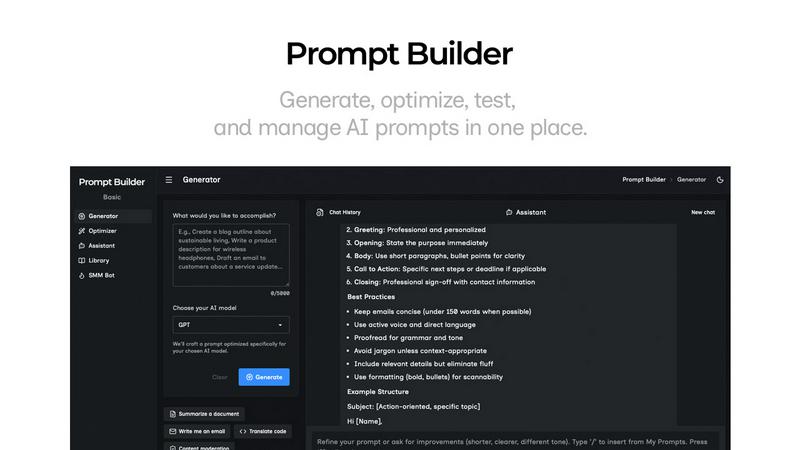
Generate, optimize, test, and manage AI prompts in one place. Turn an idea into a ready-to-use prompt in seconds.

ZoeMD
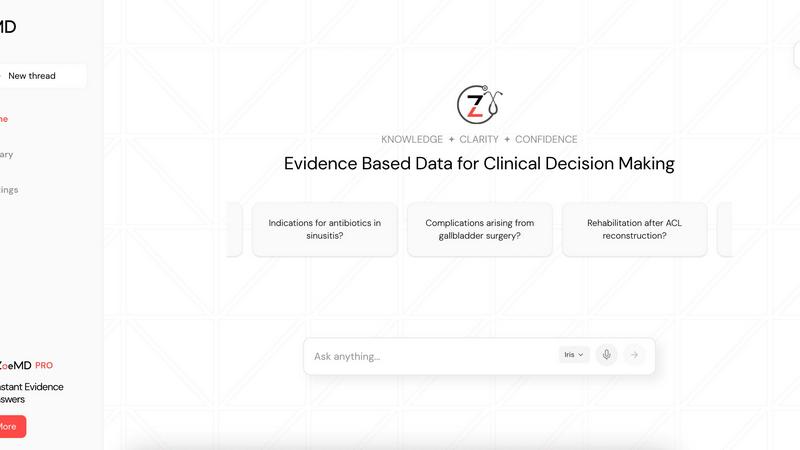
ZoeMD evolves clinical practice with instant, AI-powered access to evidence-based medical insights.
Last updated: March 1, 2026
Visual Comparison
Prompt Builder
ZoeMD
Overview
About Prompt Builder
Prompt Builder is a prompt engineering workspace for writing, testing, and saving prompts. Describe the task in plain English, and it helps you create a prompt that matches the model you choose. Start with a draft, refine it in chat, save or pin versions, then run them when you are ready. It works with GPT, Claude, Gemini, Llama, Mistral, DeepSeek, Grok, Perplexity, and more. You also get an Optimizer, an assistant for quick tests, and a library of reusable prompts and templates from the community. Turn an idea into a ready-to-use prompt in seconds. Refine it in chat, save it to your Library, and run it anytime.
About ZoeMD
ZoeMD represents a pivotal evolution in clinical workflow, transitioning from time-consuming manual research to instantaneous, intelligent support. It is an advanced, evidence-based medical AI assistant engineered specifically for healthcare professionals—including physicians, clinicians, medical students, and researchers. At its core, ZoeMD delivers rapid, reliable answers at the point of care by providing quick access to pertinent clinical guidelines, key studies, and best-practice recommendations. The platform synthesizes complex, peer-reviewed medical information into concise, structured takeaways that can be directly applied in real-world patient encounters. This progression empowers informed decision-making, enhancing speed, consistency, and confidence in daily practice. Crucially, ZoeMD is designed with a clinician-first approach, augmenting rather than replacing essential clinical judgment. By enabling users to pose questions in plain language and receive clear, evidence-backed responses, it marks a significant step forward in the journey toward more efficient, evidence-based medicine, ultimately fostering improved patient care and outcomes.