
Renderly vs WebPageSnap - Professional Web Scraper API
Side-by-side comparison to help you choose the right tool.

Renderly
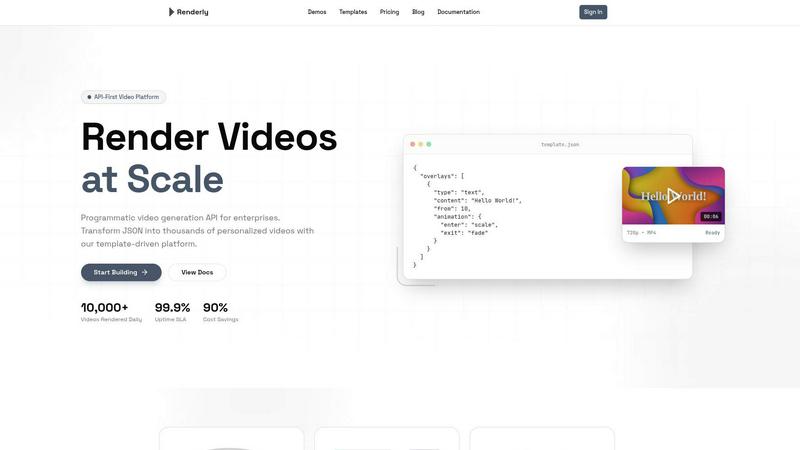
Renderly empowers enterprises to automate video production at scale, generating thousands of personalized videos.
Last updated: February 28, 2026

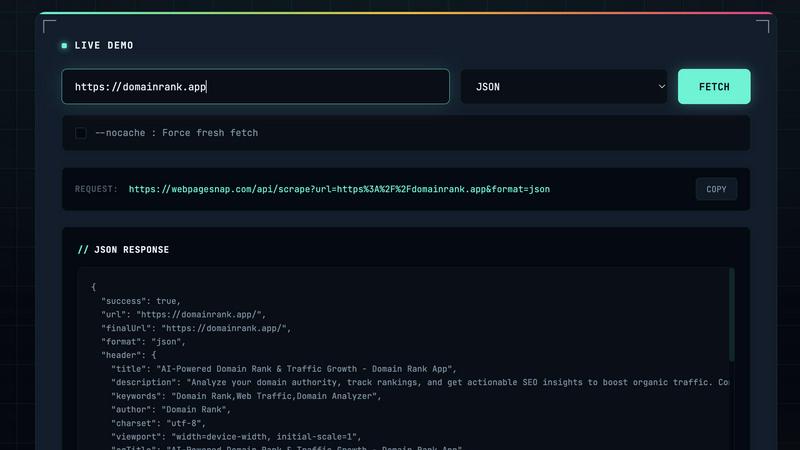
WebPageSnap is a fast and reliable web scraper API that extracts structured data from any webpage with ease.
Last updated: February 28, 2026
Visual Comparison
Renderly
WebPageSnap - Professional Web Scraper API
Feature Comparison
Renderly
API-First Architecture
Renderly features a RESTful API that is designed for seamless integration and high-volume video generation. This architecture allows developers to automate video rendering processes, making it easier to incorporate video into applications and workflows.
Template Management
With Renderly's centralized template library, users can manage their video templates efficiently. This feature supports version control, JSON configuration, and dynamic content, enabling the creation of personalized videos tailored to specific audience segments.
Scalable Infrastructure
The cloud-native platform of Renderly boasts auto-scaling capabilities that efficiently handle high-volume rendering workloads. Whether you're producing one video or 100,000, Renderly's infrastructure adapts to meet your needs without compromising performance.
Credit-Based Billing
Renderly offers transparent, pay-per-render pricing that allows users to pay only for what they render. This credit-based billing system includes volume discounts for enterprise customers, ensuring cost efficiency as businesses scale their video production.
WebPageSnap - Professional Web Scraper API
Smart Cache
WebPageSnap features an intelligent caching mechanism that leverages key-value storage with a 7-day time-to-live (TTL). This ensures a remarkable 95% cache hit rate, significantly improving the speed and efficiency of data retrieval.
Global Edge
Deployed across 200+ edge nodes globally, WebPageSnap guarantees that requests are routed to the nearest server. This edge deployment minimizes latency and ensures that users receive swift responses regardless of their geographical location.
Multi Format
The API supports multiple output formats, allowing users to receive data in either JSON or raw HTML. This flexibility makes it easy to integrate the API into various applications and workflows, accommodating different development needs.
Smart Redirect
WebPageSnap automatically follows JavaScript redirects, ensuring users receive the final page content even from JavaScript-heavy websites. This feature simulates real browser behavior, enhancing the reliability of the scraping process.
Use Cases
Renderly
Personalized Marketing Campaigns
Businesses can leverage Renderly to create personalized video messages for marketing campaigns. By automating the video creation process, companies can engage their audience more effectively, driving higher conversion rates.
Bulk Social Media Content
Renderly is ideal for brands that need to produce large quantities of social media videos quickly. With its API, users can generate thousands of videos tailored to different platforms, ensuring consistent messaging across all channels.
Data-Driven Motion Graphics
Organizations can utilize Renderly to create dynamic motion graphics based on real-time data. This is particularly useful for industries such as finance or healthcare, where timely, accurate information is crucial to decision-making.
Training and Onboarding Videos
Companies can automate the production of training and onboarding videos for new employees. Renderly allows organizations to quickly generate customized content that meets their training needs, saving time and resources in the process.
WebPageSnap - Professional Web Scraper API
Market Research
Businesses can utilize WebPageSnap to gather information from competitor websites, analyze pricing strategies, and monitor industry trends. This data-driven approach enables informed decision-making and strategic planning.
Content Aggregation
Developers can implement WebPageSnap to aggregate content from various sources into a single platform. This is particularly useful for news aggregators, comparison websites, and content curation tools that require up-to-date information.
SEO Analysis
WebPageSnap can extract essential metadata such as titles, descriptions, and Open Graph tags from target web pages. This information is crucial for SEO professionals looking to analyze competitors' online presence and optimize their own content.
Data Validation
WebPageSnap can be employed to verify and validate data across multiple websites. Businesses can use it to cross-reference information, ensuring accuracy and consistency in their databases or reporting systems.
Overview
About Renderly
Renderly is an innovative video infrastructure platform designed specifically for developers and content creators who want to streamline and automate their video production processes. By leveraging a powerful API, Renderly enables users to generate personalized videos, bulk social media content, and data-driven motion graphics quickly and efficiently. With a focus on programmatic video generation, Renderly transforms JSON data into thousands of customized videos, all while ensuring a high level of performance and reliability. As businesses increasingly recognize the value of video content, Renderly stands out as a solution that not only simplifies the creation process but also offers significant cost savings. Its template-driven architecture, auto-scaling capabilities, and comprehensive documentation make it an ideal choice for enterprises looking to scale their video production effortlessly.
About WebPageSnap - Professional Web Scraper API
WebPageSnap is an advanced web scraping API tailored to empower businesses and developers in their quest to efficiently gather and analyze web content. Hosted on the powerful Cloudflare Workers platform, it harnesses a global content delivery network (CDN) to deliver swift response times averaging around 50ms, ensuring that users can access the data they need almost instantaneously. This API simplifies the complexities involved in fetching and caching web page data, making it a vital tool for a range of applications such as market research, competitive analysis, and content aggregation. With the ability to extract crucial metadata, including titles, descriptions, and Open Graph tags, WebPageSnap provides results in both JSON and HTML formats, catering to diverse integration needs. Its impressive 95% cache hit rate, complemented by intelligent caching mechanisms, enhances overall efficiency, enabling users to concentrate on leveraging the data rather than getting bogged down in the intricacies of data collection.
Frequently Asked Questions
Renderly FAQ
What types of videos can I create with Renderly?
Renderly allows users to create a wide variety of videos, including personalized marketing videos, social media content, and motion graphics, all generated programmatically through its API.
How does Renderly ensure scalability?
Renderly's cloud-native infrastructure is designed to auto-scale, which means it can handle thousands of concurrent video renders without sacrificing performance, making it suitable for enterprises of any size.
Is there a limit to the number of videos I can create?
No, Renderly can accommodate the production of a virtually unlimited number of videos. Its infrastructure is built to grow with your business, handling everything from single video requests to bulk production.
What kind of support does Renderly offer?
Renderly provides comprehensive documentation, webhooks, and SDKs for developers, ensuring seamless integration and support throughout the video generation process. Additionally, its customer service team is available to assist with any inquiries.
WebPageSnap - Professional Web Scraper API FAQ
What is a web scraper API?
A web scraper API is a service that programmatically extracts content from websites. WebPageSnap provides structured data extraction with JSON and HTML output formats, simplifying the integration of web scraping into various applications.
How does this web scraper API handle JavaScript pages?
WebPageSnap is equipped with the capability to automatically follow JavaScript redirects. It simulates real browser behavior, ensuring that users receive the final page content, even for websites that heavily rely on JavaScript.
Is the web scraper API free to use?
Yes, WebPageSnap offers a generous free tier that allows users to make up to 100,000 requests per day. This makes it accessible for small projects, startups, and individual developers looking to explore web scraping without incurring costs.
How can I integrate WebPageSnap into my application?
Integration is straightforward. Users simply need to URL-encode the target webpage and call the API using standard HTTP requests. The flexibility of response formats (JSON or HTML) allows for easy data parsing and integration into existing systems.
Alternatives
Renderly Alternatives
Renderly is an innovative video infrastructure platform designed to streamline video production through automation. By leveraging a robust API and an intuitive online editor, it allows developers and creators to generate thousands of videos in mere minutes, making it an invaluable tool for producing personalized content, bulk social media clips, and dynamic motion graphics at scale. Users often seek alternatives to Renderly for various reasons, including pricing, specific feature requirements, or compatibility with existing platforms. When evaluating an alternative, consider factors such as ease of use, scalability, integration capabilities, and the level of support offered. These elements can significantly influence your video production efficiency and the overall quality of your content.
WebPageSnap - Professional Web Scraper API Alternatives
WebPageSnap - Professional Web Scraper API is a powerful tool designed for efficient web content extraction, catering to the needs of businesses and developers. As a prominent player in the web scraping category, it simplifies the process of gathering data from various web pages, enabling users to focus on utilizing the information effectively. However, users often seek alternatives due to factors like pricing, specific feature requirements, or the need for compatibility with particular platforms. When exploring alternatives, it is crucial to consider aspects such as ease of integration, the range of features offered, data formats available, and the efficiency of caching mechanisms to ensure that the chosen solution meets their unique needs.