
Blueberry vs Hostim.dev
Side-by-side comparison to help you choose the right tool.

Blueberry
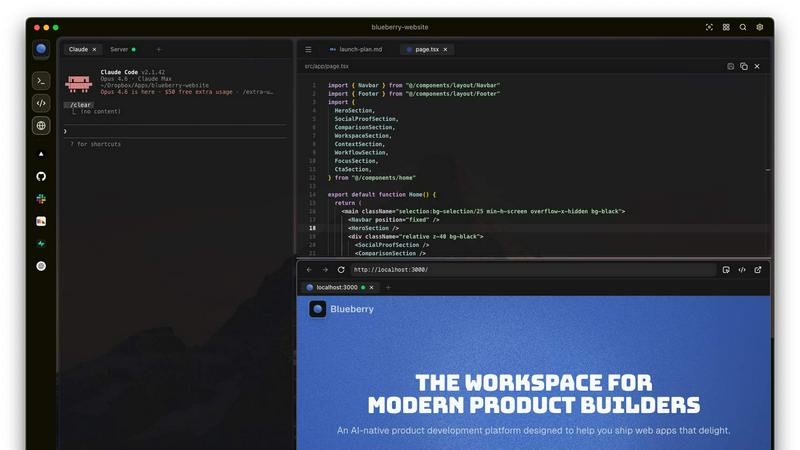
Blueberry is an AI-native workspace that unites your editor, terminal, and browser for seamless product development.
Last updated: February 28, 2026

Hostim.dev
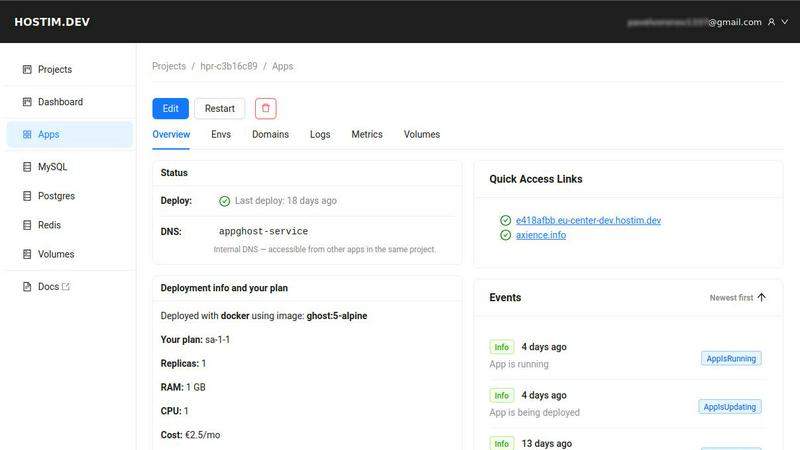
Hostim.dev evolves your Docker deployment with EU-hosted databases and simple, predictable pricing.
Last updated: March 1, 2026
Visual Comparison
Blueberry
Hostim.dev
Feature Comparison
Blueberry
Unified AI-Native Workspace
Blueberry consolidates your essential development tools—editor, terminal, and browser—into a single, managed window. This foundational feature eliminates the cognitive load and time wasted on manually arranging and switching between disparate applications. The workspace is designed from the ground up to be AI-aware, ensuring that every component is accessible and contextual for integrated AI assistants, creating a seamless and focused development environment that feels intuitive and powerful.
Built-in MCP Server for Full AI Context
This is the engine of Blueberry's intelligence. The integrated Model Context Protocol (MCP) server acts as a bridge, giving your connected AI model (like Claude or Gemini) a live, real-time view of your entire project. The AI can see your code changes as you type, read terminal output, inspect the state of your preview browser, and interact with pinned apps. This means you can ask complex, contextual questions without ever copying a snippet of code or a screenshot manually.
Pinned Apps with Shared Context
Blueberry allows you to dock and pin essential web applications like GitHub, Linear, Figma, or PostHog directly within your workspace. These apps load with your project and, crucially, share the same live context with your AI via the MCP server. This transforms your task management, design review, and analytics tools from isolated silos into integrated parts of your development flow, keeping all relevant information at your fingertips.
Visual Context with Screenshot & Element Select
Beyond code, Blueberry empowers your AI with visual understanding. You can directly capture screenshots of your live application preview or use an element selector to highlight specific UI components. This visual context is fed directly to your AI assistant, enabling it to provide feedback on design, debug layout issues, or suggest changes based on exactly what you're seeing, bridging the gap between code and its visual outcome.
Hostim.dev
Simplified Deployment from Any Source
Hostim.dev accelerates your development lifecycle by accepting deployments from the tools you already use. You can launch applications directly from a public or private Docker image, connect a Git repository for automatic updates, or paste a full Docker Compose file to replicate complex multi-service environments instantly. This flexibility means you can evolve from a simple prototype to a sophisticated microservices architecture without changing your deployment workflow, getting from code to live URL in mere minutes.
Built-in Managed Services & Persistent Storage
Eliminating the need to juggle multiple cloud service dashboards, Hostim.dev automatically provisions and wires essential backend services directly into your project's environment. With one click, you can add production-ready instances of MySQL, PostgreSQL, or Redis, which are seamlessly connected with pre-configured environment variables. Persistent volumes for your application data are equally simple to attach, ensuring your stateful data survives container restarts and updates, all managed within the same intuitive interface.
Per-Project Isolation & Security
Every project on Hostim.dev runs in its own isolated Kubernetes namespace, creating a secure boundary between your different applications or client work. This isolation is foundational for security and operational clarity. Each project benefits from automatic HTTPS via Let's Encrypt, internal private networking, live logs, and basic metrics. This "secure by default" approach means your applications are production-ready from the first deployment, protecting you and your clients from common oversights.
Transparent, Predictable Pricing & EU Hosting
Hostim.dev champions financial clarity with straightforward, per-project hourly billing starting from just €2.50 per month. You can track costs for each client or project individually, making invoicing and budgeting simple. All infrastructure is hosted on bare-metal servers in Germany, ensuring full GDPR compliance by default and low-latency access for European users. This combination of predictable pricing and sovereign data hosting removes the legal and financial uncertainties often associated with larger, more opaque cloud providers.
Use Cases
Blueberry
Rapid Prototyping and Iteration
When building a new feature or prototyping an idea, developers can code in the editor, see instant updates in the live browser preview, and use the terminal to run servers or commands—all without leaving the window. The AI can suggest code, explain errors from the terminal, and critique the UI live, dramatically speeding up the iterative build-measure-learn cycle.
AI-Powered Debugging and Problem Solving
Instead of manually correlating error messages, code, and browser state, a developer can simply ask their AI assistant, "Why is this button not working?" The AI, with full context from the terminal logs, the relevant code file, and the current browser DOM, can diagnose the issue, suggest a fix, and even implement the correction directly, turning debugging from a scavenger hunt into a guided conversation.
Streamlined Code Reviews and Onboarding
A senior developer or team lead can use Blueberry to review a pull request. With the code, the running application, and the terminal output visible simultaneously, they can comprehensively understand the changes. They can ask the AI to explain complex logic, generate tests, or assess performance implications based on the full system context, making reviews more thorough and efficient.
Context-Rich AI Collaboration
Whether you're pair programming with an AI or using it as a brainstorming partner, Blueberry provides the shared context necessary for high-level collaboration. You can ask, "How can we improve the user flow from this page?" and the AI can analyze the current component code, the live UI, and any pinned design documents to provide a coherent, actionable suggestion that considers the entire product picture.
Hostim.dev
Freelancers Shipping Client Projects
For freelancers, speed and professionalism are currency. Hostim.dev allows you to deploy a client's web app, API, or full-stack project directly from a Git repo or Compose file, dramatically reducing delivery time. The per-project billing model lets you pass on clear, predictable hosting costs to your client, and the isolated namespace ensures a clean, secure handover when the project is complete, enhancing your reputation for reliable delivery.
Agencies Managing Multiple Client Portfolios
Agencies can leverage Hostim.dev to maintain strict separation between different client projects, each in its own isolated environment. This prevents configuration drift and security risks. The platform provides a clear cost breakdown per project, simplifying internal accounting and client billing. The EU-based, GDPR-compliant hosting is a key selling point for agencies serving European customers who require strict data sovereignty.
Students & Developers Building Portfolios
Aspiring developers need real-world experience with deployment and databases, not just local coding. Hostim.dev's free trial and student-friendly pricing provide a risk-free platform to learn. Students can deploy full-stack applications using real PostgreSQL or MySQL databases, understand environment variables, and work with Docker in a production-like setting, resulting in a live portfolio piece that demonstrates practical, in-demand DevOps-adjacent skills.
Rapid Prototyping & MVP Development
When validating a new startup idea or building a minimum viable product (MVP), infrastructure should not be a bottleneck. Hostim.dev is perfect for this stage: define your app and its database in a Docker Compose file, deploy it in minutes, and share a live link with stakeholders. As the project gains traction, you can seamlessly scale CPU and RAM resources from the UI, allowing your infrastructure to evolve in lockstep with your product's growth.
Overview
About Blueberry
Blueberry represents a pivotal evolution in the product development workflow, moving beyond the fragmented toolset of the past into a unified, AI-native workspace. It is a macOS application designed for modern product builders—developers, engineers, and creators—who are focused on shipping delightful web applications. The core value proposition is profound yet simple: stop juggling windows and start building in a single, focused environment. Blueberry seamlessly integrates the three core pillars of development—a full-featured code editor, a powerful terminal, and a live preview browser—into one cohesive interface. This integration is supercharged by its native AI capabilities. By connecting to models like Claude, Gemini, or Codex via its built-in MCP (Model Context Protocol) server, Blueberry grants your AI assistant live, omnipresent context over your entire workspace. It can see your open files, terminal output, browser state, and even pinned apps like Figma or Linear. This eliminates the tedious cycle of copying, pasting, and switching contexts, allowing builders to maintain flow state and accelerate from idea to execution. Currently in a free beta, Blueberry is not just another editor; it's the next-stage platform where your tools and your intelligence work in concert.
About Hostim.dev
Hostim.dev represents the next evolution in developer-centric hosting, designed for those who have outgrown the initial prototyping phase and are ready to ship production-ready applications without descending into DevOps complexity. It is a bare-metal Platform-as-a-Service (PaaS) that provides a powerful, managed environment for containerized applications, allowing developers to progress from a local Docker setup to a secure, scalable, and fully-featured deployment in minutes. The platform is built for freelancers, agencies, and students who need to move fast, maintain control, and deliver professional results to clients. Its core value proposition lies in stripping away the cloud's inherent complexity—no YAML engineering, no surprise bills, no fragmented services. Instead, Hostim.dev offers a cohesive experience: deploy your Docker image, Git repository, or Compose file, and it automatically provisions databases, storage, networking, and security. With GDPR-compliant hosting on EU bare-metal, transparent per-project billing, and isolated environments, it provides the reliability and simplicity needed to grow your projects with confidence, ensuring your focus remains on building features, not managing infrastructure.
Frequently Asked Questions
Blueberry FAQ
What is MCP and why is it important?
MCP stands for Model Context Protocol. It is a standard that allows AI models to securely connect to and interact with external tools and data sources. In Blueberry, the built-in MCP server is crucial because it safely exposes your live workspace—your files, browser, terminal, and pinned apps—to AI models like Claude. This gives the AI a deep, real-time understanding of your project, enabling it to provide relevant, contextual assistance without you manually feeding it information.
Is Blueberry just a code editor with a terminal split?
No, it is fundamentally different. While it includes a powerful editor and terminal, Blueberry is an integrated AI-native platform. The key difference is that all components are designed to work together and feed a central AI context. The editor, terminal, and browser are not just panels side-by-side; they are interconnected nodes that your AI assistant can see and interact with simultaneously, creating a unified intelligence layer over your entire development process.
Can I use my own AI models with Blueberry?
Yes. While Blueberry showcases integrations with popular models like Claude, Gemini, and Codex, its MCP server is designed to be compatible with any AI model that supports the Model Context Protocol. This open approach allows you to connect the AI tool of your choice, giving you flexibility while still benefiting from Blueberry's unified workspace and deep context-sharing capabilities.
What does "100% FREE DURING BETA" mean?
It means that while Blueberry is in its beta testing phase, all features and functionality are completely free to use. There is no cost to download, install, or use the application. This allows the development team to gather widespread feedback and refine the product. A pricing model for the stable, production version will likely be introduced after the beta period concludes, but beta users will have ample notice.
Hostim.dev FAQ
What does the free tier include?
Hostim.dev offers a 5-day free trial that requires no credit card or sign-up. This trial gives you full access to create a project, deploy your application using Docker, Git, or Compose, and utilize the built-in services. You can test with managed databases (like PostgreSQL and MySQL on their free tiers) and persistent volumes to fully evaluate the platform's capabilities before any commitment.
Can I deploy with just a Docker Compose file?
Absolutely. Deploying with a Docker Compose file is a first-class method on Hostim.dev. You can simply paste your existing docker-compose.yml file into the platform's dashboard. It will parse the services, networks, and volumes, and deploy your entire multi-container application stack automatically, handling the internal networking and service discovery for you.
Where is my application hosted?
All applications on Hostim.dev are hosted on high-performance bare-metal servers located in a secure data center in Germany, European Union. This ensures your data remains under strict GDPR regulations by default, providing excellent latency for European users and compliance for projects that handle EU citizen data.
Do I need to know Kubernetes or DevOps to use Hostim.dev?
No, that's the core benefit. Hostim.dev abstracts away the complexity of Kubernetes and server management. You interact with a simple UI to deploy and manage your containers, databases, and scaling. The platform handles all the underlying orchestration, cluster management, security patching, and networking, allowing developers to leverage container benefits without needing DevOps expertise.
Alternatives
Blueberry Alternatives
Blueberry is a macOS application designed for developers, creating a unified workspace that integrates the essential tools of an editor, terminal, and browser. This category of all-in-one development environments aims to streamline workflows by reducing context switching and window management overhead, allowing for a more focused and efficient coding process. Developers often explore alternatives to such tools for several practical reasons. These can include platform compatibility needs, as Blueberry is currently exclusive to macOS, or specific feature requirements not yet present. Others may seek different pricing models as a product evolves from a free beta, or simply prefer a different approach to UI and workflow integration that better matches their personal habits. When evaluating alternatives, consider the core promise of a cohesive workspace. Key factors include the depth and seamlessness of integration between your code, command line, and live preview, as well as the flexibility to connect with the AI models and tools that power your specific development cycle. The goal is to find a solution that minimizes friction and maximizes your focus, allowing you to progress from idea to execution with fewer interruptions.
Hostim.dev Alternatives
Hostim.dev is a modern Platform-as-a-Service (PaaS) that streamlines the deployment of Docker-based applications. It belongs to the category of developer-centric cloud platforms, designed to eliminate DevOps complexity by automating infrastructure, databases, and networking. Developers often explore alternatives to find a solution that aligns perfectly with their project's growth stage. Common reasons include budget constraints, the need for different geographic regions, specific feature requirements like advanced scaling, or a preference for a different underlying technology stack. When evaluating other platforms, consider your application's evolution. Key factors include deployment simplicity, integrated service offerings, cost predictability, compliance needs, and the level of control versus abstraction you require. The right platform should support your current development velocity while scaling with your future ambitions.