
Blueberry vs OpenMark AI
Side-by-side comparison to help you choose the right tool.

Blueberry
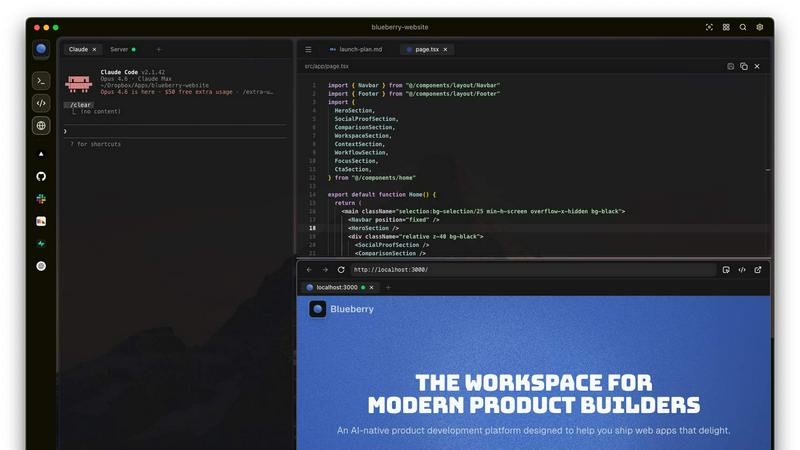
Blueberry is an AI-native workspace that unites your editor, terminal, and browser for seamless product development.
Last updated: February 28, 2026

OpenMark AI benchmarks 100+ LLMs on your task: cost, speed, quality & stability. Browser-based; no provider API keys for hosted runs.
Visual Comparison
Blueberry
OpenMark AI
Overview
About Blueberry
Blueberry represents a pivotal evolution in the product development workflow, moving beyond the fragmented toolset of the past into a unified, AI-native workspace. It is a macOS application designed for modern product builders—developers, engineers, and creators—who are focused on shipping delightful web applications. The core value proposition is profound yet simple: stop juggling windows and start building in a single, focused environment. Blueberry seamlessly integrates the three core pillars of development—a full-featured code editor, a powerful terminal, and a live preview browser—into one cohesive interface. This integration is supercharged by its native AI capabilities. By connecting to models like Claude, Gemini, or Codex via its built-in MCP (Model Context Protocol) server, Blueberry grants your AI assistant live, omnipresent context over your entire workspace. It can see your open files, terminal output, browser state, and even pinned apps like Figma or Linear. This eliminates the tedious cycle of copying, pasting, and switching contexts, allowing builders to maintain flow state and accelerate from idea to execution. Currently in a free beta, Blueberry is not just another editor; it's the next-stage platform where your tools and your intelligence work in concert.
About OpenMark AI
OpenMark AI is a web application for task-level LLM benchmarking. You describe what you want to test in plain language, run the same prompts against many models in one session, and compare cost per request, latency, scored quality, and stability across repeat runs, so you see variance, not a single lucky output.
The product is built for developers and product teams who need to choose or validate a model before shipping an AI feature. Hosted benchmarking uses credits, so you do not need to configure separate OpenAI, Anthropic, or Google API keys for every comparison.
You get side-by-side results with real API calls to models, not cached marketing numbers. Use it when you care about cost efficiency (quality relative to what you pay), not just the cheapest token price on a datasheet.
OpenMark AI supports a large catalog of models and focuses on pre-deployment decisions: which model fits this workflow, at what cost, and whether outputs are consistent when you run the same task again. Free and paid plans are available; details are shown in the in-app billing section.