
FilexHost vs Miget
Side-by-side comparison to help you choose the right tool.

FilexHost evolves your file sharing from simple uploads to powerful, secure hosting for any project.
Last updated: February 28, 2026

Miget
Deploy unlimited services on one flat-rate plan.
Visual Comparison
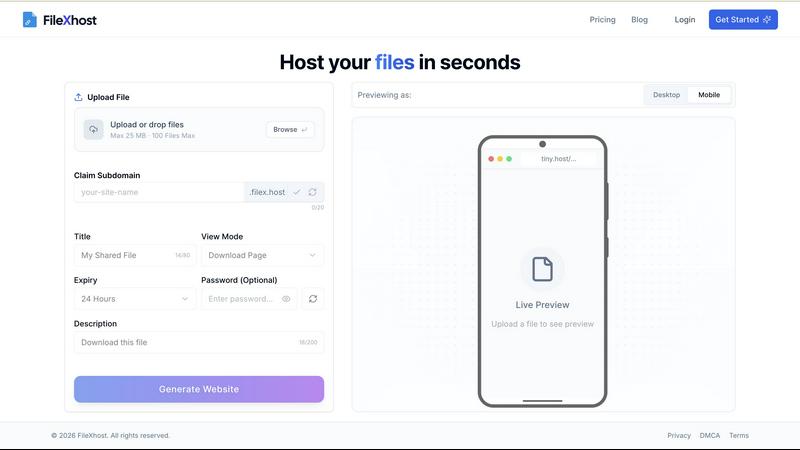
FilexHost
Miget
Overview
About FilexHost
FilexHost represents the next evolution in digital file sharing, transforming a traditionally complex process into a seamless, instantaneous experience. It is a universal hosting platform designed for professionals, creators, and developers who need to share files and static websites without the friction of traditional methods. The core value proposition is profound simplicity: a "Drop & Share" workflow that eliminates servers, DNS configurations, and mandatory logins for recipients. FilexHost intelligently renders over 100 file types, from documents and spreadsheets to full HTML projects, presenting them as beautiful, interactive experiences directly in the browser. This focus on the viewer's journey ensures your work is seen exactly as intended, whether it's a client report, a product demo, or a portfolio piece. The platform grows with your needs, starting with a robust free tier for testing and quick shares, and scaling to a Pro plan for permanent, high-traffic hosting with advanced controls. FilexHost is more than a tool; it's a streamlined pathway from your desktop to your audience, built for a world that moves at the speed of an idea.
About Miget
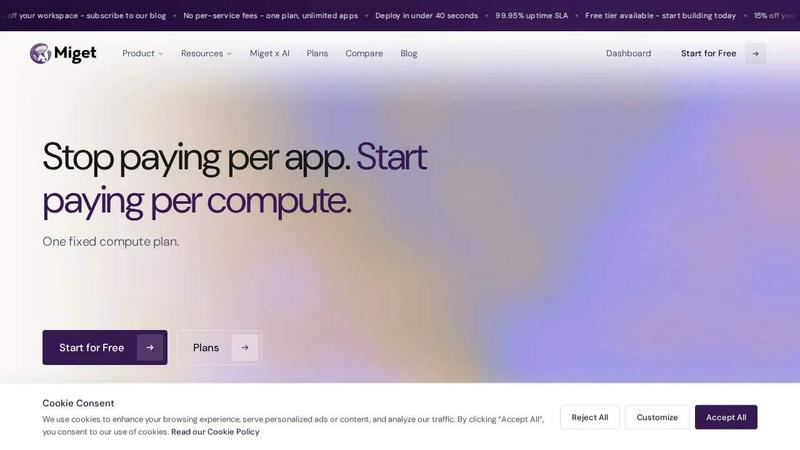
Miget – Stop paying per app. Start paying per compute.
Traditional PaaS platforms charge you for every app, database, and worker separately. Miget flips that model: pick a fixed compute plan, then deploy as many services as you want inside it.
- Unlimited apps, databases, and background workers per plan
- No per-service billing surprises
- Built on Kubernetes with full isolation between tenants
- Deploy from Git, GitHub, Registry with zero-config builds
- Managed PostgreSQL, Redis, and more
- Custom domains with automatic TLS
Whether you're running a single side project or a full production stack, you only pay for the compute you reserve—not the number of things you run on it.