
Code Word Solver - Missing Words Finder vs Psychiatry Exams
Side-by-side comparison to help you choose the right tool.

Code Word Solver - Missing Words Finder
Master codewords by evolving from novice to expert with our intuitive pattern-solving tool.
Last updated: February 28, 2026

Psychiatry Exams
Evolve from candidate to consultant with AI-powered MRCPsych exam preparation.
Last updated: March 1, 2026
Visual Comparison
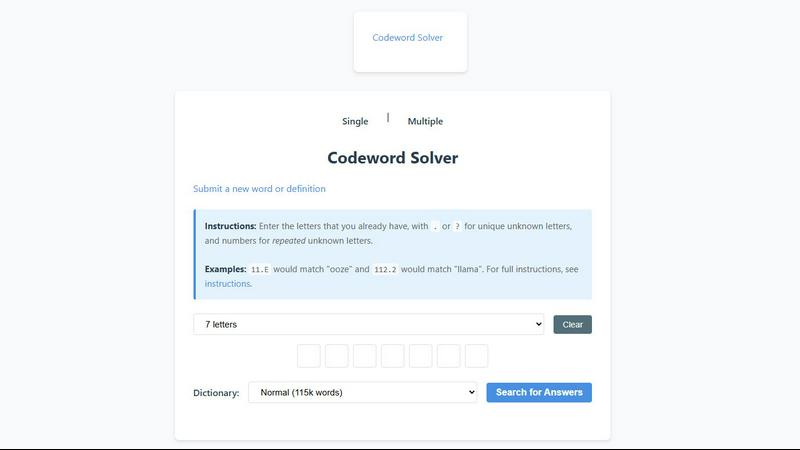
Code Word Solver - Missing Words Finder
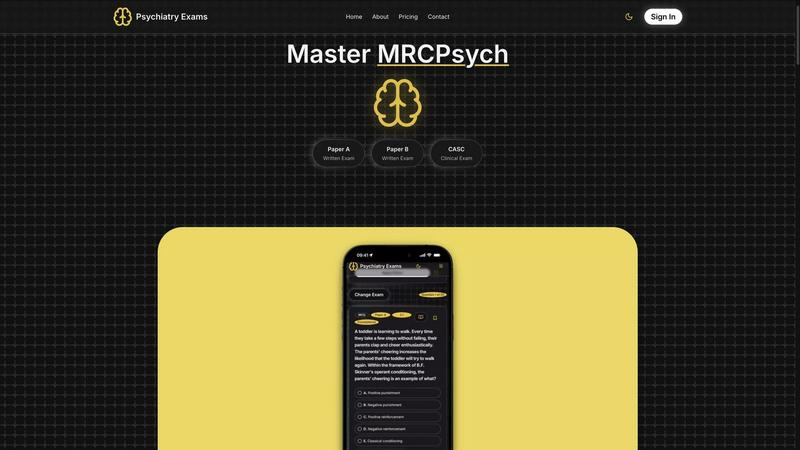
Psychiatry Exams
Feature Comparison
Code Word Solver - Missing Words Finder
Dual-Mode Pattern Solving
This feature marks a pivotal stage in solving efficiency, offering two distinct pathways to a solution. For isolated challenges, the Single Pattern mode allows you to input one word pattern for immediate candidate words. The advanced Multi-Pattern mode is a game-changer for interconnected puzzles, letting you solve two linked words simultaneously. This mirrors the puzzle's own logic, where solving one word reveals number/letter pairs that instantly unlock others, dramatically accelerating the entire decoding process and reducing recursive guesswork.
Intelligent Pattern Recognition Syntax
Moving beyond simple blank spaces, the solver employs a sophisticated syntax system that understands letter repetition within a word. By using numbers to denote repeated unknown letters (e.g., "112.2" for "llama"), the tool ensures consistency in its search, filtering out thousands of incorrect possibilities. This intelligent pattern-matching is the cornerstone of its accuracy, allowing you to input exactly what you know—be it confirmed letters (A, B, C), unique unknowns (., ?), or repeated unknowns (1, 2, 3)—for a hyper-targeted result.
Tiered Difficulty Dictionaries
Recognizing that not all puzzles or solvers are created equal, this tool provides curated word lists to match your specific stage of growth. Choose the expansive "Hard" dictionary (260k words) for the most challenging puzzles, the balanced "Normal" list (115k words) for standard play, or the focused "Easy" list (20k words) for beginners or quicker solves. This tiered approach ensures the tool scales with your skill level, preventing beginners from being overwhelmed and experts from being limited.
Community-Powered Word Database
The solver is built on a living, evolving foundation. The community-powered database ensures continuous improvement and coverage. If you encounter a valid word missing from the lists, you can submit it directly, contributing to the tool's collective intelligence. This means the solver grows more comprehensive and effective over time, fueled by its own user base, ensuring it remains a reliable partner as puzzle lexicons evolve.
Psychiatry Exams
Verified Recalled Question Bank
The foundation of the platform is its extensive repository of over 2,400 recalled questions from actual MRCPsych exam sittings. This isn't just a raw collection; each question is carefully adapted, verified, and moderated by a team of eight NHS consultants. This process ensures clinical accuracy and relevance, providing users with the most authentic practice experience possible, directly mirroring the style and difficulty of the real Paper A, Paper B, and CASC exams.
AI-Powered Expert Explanations
Moving past simple answer keys, Psychiatry Exams leverages a sophisticated AI ensemble—including Claude Opus, Gemini, and GPT models—to generate deep, insightful explanations for every question. This system is uniquely combined with consultant expertise and is continuously updated against the official syllabus. The result is a learning tool that doesn't just tell you what is correct, but explains the underlying principles, helping to build a robust and lasting conceptual understanding.
Active Learning & Credit System
The platform champions an active learning methodology where users are incentivized to contribute their own questions. For each submission, users earn AI credits, with a bonus awarded when their question is approved by moderators. This process of creation and peer review forces a deeper engagement with the material, transforming passive revision into an active, critical thinking exercise that dramatically improves knowledge retention and synthesis.
Integrated Community & Syllabus Mapping
Psychiatry Exams fosters a thriving support network through a dedicated WhatsApp community with discussion areas for each exam sitting, moderated by consultants, and group calls. This is complemented by complete syllabus coverage, where all content is meticulously mapped to official Royal College learning objectives and study notes reflect the latest reading materials, ensuring users' study efforts are always focused and efficient.
Use Cases
Code Word Solver - Missing Words Finder
Breaking Through a Stubborn Mental Block
Every solver reaches a point where the grid seems impenetrable. Instead of resorting to random guesses that can derail the entire puzzle, input your partial word patterns. The solver will provide a manageable shortlist of candidates, offering the fresh perspective and logical next step needed to break the deadlock and regain momentum, transforming frustration into a satisfying breakthrough.
Verifying a Potential Solution with Confidence
After deducing a possible word, it's crucial to confirm it fits the global puzzle pattern. Enter your hypothesized word as a pattern to see if it exists in the selected dictionary. This verification step acts as a safety net, preventing cascading errors and building the confidence to firmly pencil in letters, knowing they are supported by the solver's extensive lexical database.
Learning and Improving Solving Techniques
For players in the growth stage, the solver is an excellent educational tool. By experimenting with different pattern inputs and observing the results across the three dictionaries, you can develop an intuition for common word structures, letter frequencies, and puzzle construction. It helps you internalize strategies, gradually relying less on the tool and more on your own honed deductive skills.
Solving Interconnected Words Efficiently
When two or more words in the grid share several unknown numbers, their solutions are deeply linked. Using the Multi-Pattern solving mode for this scenario is the most efficient progression. It cross-references possibilities for both words simultaneously, instantly identifying the mutually compatible solutions that would take much longer to find by solving each word in isolation, showcasing a masterful application of the puzzle's core rules.
Psychiatry Exams
Systematic Exam Preparation for Trainees
A CT1-3 psychiatry trainee uses the platform as their primary study companion throughout their exam journey. They follow the syllabus-mapped content, methodically work through the recalled question banks for Paper A and B, and use the spaced-repetition flashcard system to cement core knowledge, creating a structured and comprehensive preparation plan that evolves with their learning stage.
CASC Clinical Skills Refinement
An ST4-6 registrar preparing for the Clinical Assessment of Skills and Competencies (CASC) exam utilizes the platform's library of CASC vignettes. They practice these simulated patient scenarios, study the model approaches, and engage in the community discussions to refine their clinical communication, examination techniques, and management planning in a low-stakes, feedback-rich environment.
Knowledge Consolidation Through Contribution
A user aiming to move from memorization to mastery engages deeply with the active learning system. They read a topic, then challenge themselves to write a high-quality MCQ based on it. By submitting this for peer and consultant review, they solidify their understanding, uncover gaps in their knowledge, and earn credits, turning consumption into creation for a more profound learning evolution.
Last-Minute Revision & Confidence Building
In the final weeks before an exam sitting, a candidate uses the platform's mock exams to simulate the real testing environment and timing. They focus on their weak areas identified by performance analytics, review AI explanations for incorrect answers, and participate in community group calls for final clarifications, building exam-day confidence and mental readiness.
Overview
About Code Word Solver - Missing Words Finder
The Code Word Solver - Missing Words Finder represents a significant evolution in puzzle-solving strategy, transitioning players from a state of frustrating guesswork to one of confident, logical deduction. Designed specifically for codeword (or code-cracker) puzzles, this tool is built for the dedicated solver who has hit a wall. Codewords replace every letter in a grid with a unique number from 1 to 26, creating a complex web of interconnected clues. The solver's core value proposition is its ability to analyze the patterns you've uncovered and instantly filter through vast dictionaries to present only the words that fit the precise cryptographic structure you're working on. It's more than just a word list; it's a dynamic assistant that respects the puzzle's rules, applying the same letter-to-number mapping across the entire grid. Whether you're a casual enthusiast looking to enjoy a puzzle without the headache or a competitive solver aiming to shave minutes off your time, this tool is engineered to support your growth from novice to expert, providing the logical scaffolding needed to decode any grid with precision and speed.
About Psychiatry Exams
Psychiatry Exams represents a significant evolution in professional medical exam preparation, moving beyond static question banks to a dynamic, community-powered learning ecosystem. Designed specifically for psychiatry trainees navigating the challenging MRCPsych examination pathway, this platform consolidates every essential resource into a single, mobile-friendly hub. It serves a clear mission: to democratize access to high-quality preparation by streamlining the process and reducing the financial burden often associated with these high-stakes exams. At its core, Psychiatry Exams fosters a culture of active, collaborative learning. It empowers users not just to consume content, but to contribute to it, creating a virtuous cycle where the community's collective knowledge strengthens every member's preparation. This growth-focused model, underpinned by cutting-edge AI and moderated by practicing NHS consultants, ensures the material is not only vast—with thousands of recalled questions—but also precise, relevant, and aligned with the latest Royal College syllabus. The journey here is from isolated studying to integrated mastery, preparing candidates not only to pass their exams but to evolve into more confident, knowledgeable clinicians.
Frequently Asked Questions
Code Word Solver - Missing Words Finder FAQ
How do I enter a pattern for a word with repeating letters?
Use numbers to represent repeated unknown letters. Each unique number corresponds to a single, consistent unknown letter. For example, the pattern "112.2" tells the solver: "The first and second letters are the same unknown letter, the third is a different unknown, the fourth is a known 'A', and the fifth letter is the same as the second letter." This would correctly match a word like "llama".
What is the difference between the Hard, Normal, and Easy dictionaries?
The dictionaries represent different stages of lexical coverage to suit various puzzle difficulties and player preferences. The "Hard" dictionary contains 260,000 words for the most challenging puzzles. The "Normal" dictionary has 115,000 words, suitable for standard publications. The "Easy" dictionary, with 20,000 words, is perfect for beginners, quicker puzzles, or when you want to avoid obscure words, streamlining the solving process.
Can I use the solver for a full codeword grid at once?
The current evolutionary stage of the tool is focused on solving individual or linked word patterns, which are the fundamental building blocks of the entire grid. By solving key words one or two at a time using the pattern system, you progressively unlock the letter-to-number key. This key then allows you to solve the rest of the grid directly, making this methodical approach the most effective way to complete the puzzle.
What should I do if the word I need isn't found by the solver?
You can contribute to the tool's growth by submitting the missing word via the "Submit a new word or definition" link. This community-powered feature ensures the database expands and improves over time, helping both you and future solvers. Before submitting, double-check your pattern syntax and try a different dictionary tier, as some words may only appear in the "Hard" list.
Psychiatry Exams FAQ
How accurate and reliable are the recalled questions?
The questions are highly reliable as they are sourced from candidates' recollections from actual exam sittings. More importantly, every single question is then rigorously adapted and clinically verified by a team of practicing NHS consultants to ensure medical accuracy, alignment with current guidelines, and relevance to the official MRCPsych syllabus before being published on the platform.
What is the "Active Learning" approach and how does it help?
The active learning approach shifts your role from a passive consumer of information to an active participant in the learning process. By incentivizing you to create your own exam questions, the platform forces you to engage with the material at a much deeper level—synthesizing information, identifying key points, and applying critical thinking. This process, proven by educational research, leads to significantly better understanding and long-term retention compared to simply reading or answering questions.
How does the platform stay up-to-date with syllabus changes?
Psychiatry Exams employs a multi-layered update system. The state-of-the-art AI models are continuously fine-tuned with the latest syllabus publications and College reading materials. Furthermore, the team of consultant moderators regularly reviews all content against any announced changes. The community-driven model also means new recalled questions from the most recent exam diets are quickly integrated, keeping the question bank current and relevant.
Is there support for the CASC clinical exam?
Yes, the platform provides dedicated comprehensive support for the CASC exam. This includes a growing library of practice clinical vignettes that simulate real stations, allowing you to practice your clinical reasoning, communication skills, and management plans. Additionally, the community aspect facilitates discussions on CASC techniques, and the syllabus coverage ensures all clinical assessment objectives are thoroughly addressed.
Alternatives
Code Word Solver - Missing Words Finder Alternatives
Code Word Solver - Missing Words Finder is a specialized online tool designed for puzzle enthusiasts, specifically those tackling codeword or code-cracker puzzles. It belongs to the category of digital puzzle aids, helping users decode grids by analyzing letter patterns and number mappings to suggest possible word solutions. This tool represents the evolution of puzzle-solving from pure guesswork to a more strategic, pattern-recognition approach. Users often explore alternatives for various reasons. Some may seek different pricing models, such as one-time purchases versus subscriptions, while others look for specific features like mobile app integration, offline functionality, or integration with particular puzzle publications. Platform preference, user interface design, and the depth of the word database are also common factors driving the search for different tools. When evaluating an alternative, consider the core functionality that matches your puzzle-solving stage. A beginner might prioritize an easy-to-use interface with tutorial support, while an advanced solver needs a robust, extensive dictionary and advanced pattern-matching capabilities. The ideal tool should grow with your skills, offering the right balance of assistance and challenge to facilitate your progression as a solver.
Psychiatry Exams Alternatives
Psychiatry Exams is a mobile-first educational platform designed to help medical professionals master the MRCPsych examinations. It falls within the specialized category of high-stakes medical exam preparation, where learners seek efficient, consolidated resources to navigate a challenging syllabus. Candidates often explore different options to find the right fit for their unique journey. This search can be driven by budget considerations, a need for specific study tools like question banks or flashcards, or a preference for certain learning methodologies and community interaction levels. The evolution of a learner's needs, from foundational knowledge to advanced application, means the ideal platform can change as they progress. When evaluating any study aid, focus on the core elements that drive growth. Key considerations include the quality and relevance of the practice material, the depth of explanations that foster true understanding, and whether the platform's design supports your personal learning rhythm and stage of exam preparation.